The Tzer Island book blog features book reviews written by TChris, the blog's founder.  I hope the blog will help readers discover good books and avoid bad books.  I am a reader, not a book publicist.  This blog does not exist to promote particular books, authors, or publishers.  I therefore do not participate in "virtual book tours" or conduct author interviews.  You will find no contests or giveaways here.

The blog's nonexclusive focus is on literary/mainstream fiction, thriller/crime/spy novels, and science fiction.  While the reviews cover books old and new, in and out of print, the blog does try to direct attention to books that have been recently published.  Reviews of new (or newly reprinted) books generally appear every Monday, Wednesday, and Friday.  Reviews of older books appear on occasional weekends.  Readers are invited and encouraged to comment.  See About Tzer Island for more information about this blog, its categorization of reviews, and its rating system.

Entries in Italy (12)

Monday
Apr232012

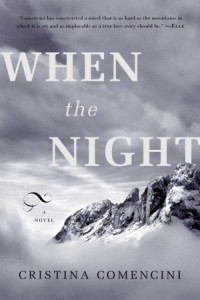
When the Night by Cristina Comencini

First published in Italian in 2009; published in translation by Other Press on April 24, 2012

When the Night is a dark and oddly beautiful story of two regret-filled souls struggling to break free from their confining personalities.  The novel records two intersecting moments in their lives, fifteen years apart -- in many ways their most vital moments.

Mountain guide Manfred Sane and his brothers were raised by their father after their mother ran off with an American tourist.  Before the novel opens, Manfred’s wife, Luna, has left, taking their children with her.  Manfred has rented an apartment above his to Marina, who has taken her son to the mountains for a month, leaving her husband behind.  Marina is depressed; she hasn’t bonded with her son Marco, she never sleeps, she feels lonely and inadequate.  She is the opposite of the Supermom:  she wasn’t cut out for motherhood and she knows it.  Still, she hopes her stay in the mountains will renew her strength.

Manfred is silent, bitter, and abusive.  He learned from his father that women are not to be trusted.  Manfred’s observation of Marina, and particularly of her coma-like response when Marco is injured, reinforces his belief that children should be taken away from their mother as soon as they are born.  He suspects that Marina has deliberately harmed Marco, a suspicion instilled by his long-standing contempt for women.  He considers it his duty to provoke her confession.

As the novel unfolded I wondered whether it would turn into an unlikely love story or whether Manfred would kill Marina.  Are they two ships passing in the night or two ships colliding?  In its final section, When the Night jumps forward fifteen years.  The change (or lack of fundamental change) in the characters during the gap years makes clear that the month Marina spent in the mountains was pivotal for both of them.  But what does the present hold?

When the Night is told from the alternating points of view of Manfred and Marina.  Sometimes, when the two are together, the point of view changes from sentence to sentence.  The mild confusion that technique occasionally causes is more than offset by the value of seeing the same events almost simultaneously from opposing perspectives.

This isn’t a novel for readers who search for likable characters.  Still, there is understanding to be gained from the rather extreme examples the main characters offer of gender-based personality differences.  Although Marina is far from a prototypical female (given her lack of maternal instinct) and Manfred is a poor example of a male (given the disgust he feels in the company of women), their interaction with each other is quite typical:  Marina probes for a way to connect while Manfred is guarded, unwilling to open himself for her inspection.  Their differing perceptions impair their ability to communicate; they often speak at cross-purposes, fighting to connect in a moment of shared honesty.

It is in their extremes, however, that the characters offer the most insight.  Both characters are filled with self-loathing, although Marina is more honest with herself.  Manfred feels protective of Marco, perhaps with some cause but also because he distrusts the ability of any woman to raise a male child -- a product of his feeling of abandonment by his mother.  More than that, he feels the need to punish Marina for being a bad mother (perhaps born of a desire to punish his own mother).  He believes “you need to be strong to raise children” and Marina is anything but strong.  Manfred is the personification of misogyny yet he finds himself drawn to Marina, seemingly against his will.  Marina both loves and hates her son.  She loves her husband but hates him for not understanding her.  She yearns for romance but doesn’t believe in it; she views husbands as interchangeable, the choice of one man versus another as arbitrary, yet she finds herself drawn to Manfred.

Manfred’s perspective is told in stark language, featuring the sort of abruptly ending sentences that befit a man who doesn’t like to talk.  Marina’s perspective is narrated in a more descriptive style.  In both cases, Cristina Comencini writes penetrating prose that fully reveals two tortured individuals, apparently incapable of becoming the persons they want to be.  This short novel virtually chisels its characters from the mountains that surround them, exposing multiple facets, sharp edges, hidden features and cold facades.  Fans of character-driven fiction are particularly likely to regard When the Night as a memorable novel.

RECOMMENDED

Tuesday
Apr122011

Quiet Chaos by Sandro Veronesi

Published in translation by Ecco on April 12, 2011; first published in 2005.

After Lara, the mother of his child, unexpectedly dies while Pietro is at the beach saving the life of a drowning stranger, Pietro spends his days in his car outside his daughter’s school, contemplating the quiet chaos of children spilling out of the building, experiencing an almost euphoric relaxation that has taken the place of grief.  A good bit of the novel takes place in Pietro’s mind as, in his thoughts, he justifies the affairs he had before Lara died, considers his absent feelings of loss, judges the friends and co-workers who visit him in his parked car and is judged by Lara's sister, with whom he had a fling before he met Lara.  Pietro is an executive in the Milan office of a cable television company that is undergoing an international merger, creating another element of chaos as his boss is sacked, but Pietro -- despite daily visits from company officers and employees -- is indifferent to the workplace turmoil, finding peace and tranquility in the park adjacent to the school, where he engages in amiably superficial conversation with the woman who takes her golden retriever for a daily stroll and plays a recurring game with a Down’s Syndrome child whose mother is taking him to physical therapy sessions. 

There’s something seductive about Sandro Veronesi’s prose, something that drew me in and held my attention even when nothing much was happening.  Other than the early scene in which Pietro and his brother save two women from drowning, there is little action in Quiet Chaos.  There is, instead, a good bit of observation and contemplation.  Pietro listens to Radiohead and decides that the few lyrics he can understand are meant for him, messages from Lara.  He begins to see himself as a symbol of pain, to see his car as a wailing wall without the wall, a fixture planted in front of the school so that others, imagining his sorrow, can feel they are sharing their own suffering with him.  The world happens all around him -- his daughter takes dance lessons, a stranger makes lunch for him, a new car parked by the school is damaged in two different accidents, a co-worker disappears after mistaking the CD drive in his laptop for a cup-holder -- and Pietro stands apart from it all.  One of the few times Pietro is “in the moment” comes during a passionate encounter with a woman (an extended, wonderfully written scene that is nonetheless quite graphic; readers who are turned off by scenes of that nature should stand warned) and even then Pietro suddenly becomes aware that he’s “in the moment,” thereby transforming himself from actor to observer.

For a meandering novel that is in many ways quietly chaotic, the ending offers a surprising amount of resolution and closure. While on its surface Quiet Chaos is about a man coming to terms with his life after his significant other’s death, there’s a lot going on here, more than I am able to articulate in a brief review.  I expect that additional meaning will creep into my consciousness as I continue to think about this fine novel.  Readers who are looking for an action-filled plot will likely be disappointed by Quiet Chaos, but I appreciated Sandro Veronesi’s strong, vividly detailed writing, his intense characters, and his illuminating ideas.  When I finished the novel I pondered whether to give it my highest recommendation but it keeps nagging at me, I keep thinking about it, and on the strength of its impact on my thoughts alone I’ve decided it deserves to be highly recommended. 

HIGHLY RECOMMENDED

Page 1 2 3