The Tzer Island book blog features book reviews written by TChris, the blog's founder.  I hope the blog will help readers discover good books and avoid bad books.  I am a reader, not a book publicist.  This blog does not exist to promote particular books, authors, or publishers.  I therefore do not participate in "virtual book tours" or conduct author interviews.  You will find no contests or giveaways here.

The blog's nonexclusive focus is on literary/mainstream fiction, thriller/crime/spy novels, and science fiction.  While the reviews cover books old and new, in and out of print, the blog does try to direct attention to books that have been recently published.  Reviews of new (or newly reprinted) books generally appear every Monday, Wednesday, and Friday.  Reviews of older books appear on occasional weekends.  Readers are invited and encouraged to comment.  See About Tzer Island for more information about this blog, its categorization of reviews, and its rating system.

Entries in HR (69)

Monday
May042026

Five by Ilona Bannister

Published by Crown on May 5, 2026

Five is the number of characters who might die before the novel Five ends. We know someone will die because Ilona Bannister tells us that in the novel’s early pages. Bannister describes the potential dead as “the child, the mother, the businessman, the old woman, and the gambler.” We know them as Gideon, Emma, Liam, Mrs. Worth, and Sonny.

The plot is organized around those characters as they converge in a subway station. Some are on the track as a delayed train begins to approach. One has decided to commit suicide. A character who remains on the platform is having a heart attack. The child is balance-walking along the lip of the platform as the train approaches. Their fates unfold in minutes, but the death drama is broken up by backstories that take the reader on a journey through each life, from infancy to the present.

Gideon is the child from hell. He never bonded with his mother Emma. He disobeys her, hits her with her high heel shoe, booby traps the cupboard so a rolling pin will fall on her when she opens it. Child psychologists have done nothing to improve his behavior. Nannies have quit, the most recent one after Gideon crapped in her shoes. When Gideon, having escaped Emma’s grasp, almost falls onto the subway tracks, she briefly considers not catching him.

If Gideon is the child from hell, Mrs. Worth might be the mother from hell. Not her fault, really, given her own motherless childhood. Mrs. Worth (she hates the name Matilda) was raised by a father who was a surgeon in the war until the atrocities he observed caused him to lose his grip. As a child, Matilda’s father taught her how to dissect dead animals, some of which (including the neighbor’s dog) he kills for that purpose. Mrs. Worth, now a pathologist, is distant from her own son (conceived by one of the lovers whose sexual performance she charted in her lab notes), a distance that grew when she realized she was turning into her father.

Sonny was another bad kid, in the sense that he’s hyperactive and has no use for rules that are meant to restrain him. By the time he reaches the subway platform in his late twenties, Sonny has a serious gambling addiction and has given up on himself. He understands that he doesn’t “fit into a world that was not built for people like him.”

Sonny was in nursery school when his father died. His mother Luna, beside herself with grief, can’t take Sonny out in public for fear that his misbehavior will annoy others. In challenging Sonny’s teachers to be less boring. Luna won’t admit that her son has any problems of his own making because doing so would cause her to blame herself for not raising him properly.

Liam grew up in a poor family with a disabled brother and devoted mother. Liam and his brother Danny overcame hardships, grew a business, and hired Emma as their CFO. Liam marries a woman and stays with her until she becomes “a bit old and puffy.” While he is with his third wife, Emma decides he would be a perfect sperm donor. But Liam’s story is less about Emma and more about the damage he does to his relationship with his brother because he fears he will lose Danny to the caregiver Danny loves.

So will one of them really die? Ilona Bannister telegraphs the outcome well before it arrives: “There is no open-ended scene where you are left guessing if perhaps everyone survives in the end and the story is just a comment on the fragility of the human condition and the diversity of human suffering: a clever mechanism to remind us that everyone has a story, and not everyone is who or what they seem.” But that’s exactly what the novel is, regardless of the outcome. Five people with complex histories are together in a moment that will shape the rest of four lives and end the fifth.

Bannister assumes that readers will pick a favorite character for an early grave and will root for others to survive. She then challenges the reader to ask why one character is “worthy of surviving in the internal universe of your brain” while another is not. The novel’s brilliance lies in that philosophical inquiry.

Motherhood is a theme that ties the stories together. Even when mothers do their best, they are blamed for the sins of their children. Mothers, “even if they were good mothers, even if they had sacrificed for and loved their boys, even if they had given them good homes, were still and always would be the bad mothers of terrible sons.”

Bannister plays with the novel’s form, occasionally using her narrative voice to speak directly to the reader, as when she explains to readers that they might view surviving characters as having metaphorically died in part, “if you like those kinds of metaphors. Metaphors about life and death, or the death of the spirit versus the death of the body, or the death of the past to enable the birth of the future, these are always good topics to raise in book club when the conversation lags.” Because talking about metaphors is easier than talking about why we wanted a particular character to die. I’m not usually a fan of an author’s intrusion into the narrative, but Bannister guides the reader to lessons that are too important to miss.

The story is sad but life-affirming. Do you deserve a better fate than her characters, Bannister asks. It doesn’t matter what we think we deserve. We all live for a time, experiencing moments of pain and moments of joy before we inevitably die. An author can decide which character will die but, in life, those choices seem random. All we can know is that “life and death happen because they do.” At the same time, Five is a testament to “how extraordinary ordinary people are.”

Five delivers the tension of a thriller and the deep character development of a literary novel. Bannister’s prose is precise in its depiction of human nature. She is brutal in her honest observation of human failings but compassionate in her understanding of human weaknesses. Five is the best novel I’ve read in 2026 and may be the best novel I’ll read this year.

HIGHLY RECOMMENDED

Monday
Mar252024

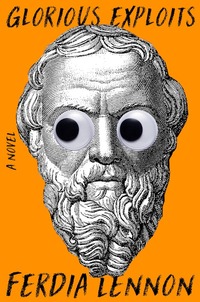
Glorious Exploits by Ferdia Lennon

Published by Henry Holt and Co. on March 26, 2024

I never tire of reading, but I do get tired of reading the same plots in book after book. Readers who think (in the words of Monty Python) it’s time “for something completely different” might want to check out Glorious Exploits. The novel is funny, surprising, and poignant.

The story is set in Syracuse early in 4th century BC. Syracuse at that point was populated by Greeks, but the prose is 21st century British (“Still a gobshite, I see.”).

Toward the end of the 5th century BC, Syracuse was invaded by Athens. With the help of Sparta, Syracuse defeated the Athenians. The story begins with captured Athenians imprisoned in a quarry, where they are visited by Lampo and Gelon, two unemployed potters. Like most Greeks in Syracuse, Lampo and Gelon are fans of Athenian theater. They are convinced that nobody does Euripides like the Athenians. On a visit to the quarry, Gelon gets it into his head to put on a production of Medea using the Athenians to act out the play. He finds a few who have acting experience and who know the parts. Lampo is taken with a green-eyed Athenian who he believes will be perfect for the part of Jason.

Lampo is even more taken with Lyra, a slave from Lydia (a kingdom that once existed on land that is now in Turkey). Lyra is owned by the proprietor of a tavern that Lampo often visits. Lampo falls in love with Lyra and promises to one day buy her freedom. That will be a difficult promise for an unemployed potter to keep, although it gives Lampo a resolve and purpose that he previously lacked.

Equal parts comedy and tragedy, the story follows Lampo as he works with Gelon to produce Medea. The captive Athenians are slowly starving to death, but the actors are incentivized by bread and wine. As Gelon and Lampo are casting the roles, they find an Athenian who not only knows Medea, but has acted in Euripides newest play, Trojan Women. Gelon believes that Athens is doomed and decides they must save the new play by bringing it to life. To that end, they plan to produce both plays.

Their plans come to the attention of a wealthy businessman named Tuireann who is passing through Syracuse. He provides the gold that Gelon and Lempo need to purchase sets and costumes to stage the play correctly. Yet not all Syracusans are pleased that the Athenians who killed their family members during a siege of the city are being treated so well. Will the plays ever be produced in the face of such hostility?

Glorious Exploits is in equal parts a comedy and a tragedy. Euripides (we are told at the end) “was ever in love with misfortune and believed the world a wounded thing that can only be healed by story.” Most of the story in Glorious Exploits unfolds between the invasion of Syracuse by Athens and its invasion by Carthage. During the years when Syracuse is free from invaders, Gelon and Lampo contrive to heal their wounded city with stories told by Euripides. Misfortune does indeed seem to be the human condition, particularly for slaves and captured soldiers who are starving to death in a pit. Some of them, at least, might be healed before the story ends.

The story told by Ferdia Lennon also has healing value. It is a story about the redemptive power of love and a story of the enduring power of Lampo’s rocky friendship with Gelon, but it is also the story of an unlikely friendship between Lampo and a conquered Athenian. The novel eventually becomes a story of how we should treat our enemies and whether we should think of other humans as enemies at all — at least in moments when we are not trying to kill each other.

Glorious Exploits has everything this reader could want: silliness, drama, excitement, unexpected twists, a story worth telling and lessons worth learning. The story is told in pitch-perfect prose that restores ancient Syracuse to its momentary glory. The year is young, but this is the best book I’ve read so far in 2024.

HIGHLY RECOMMENDED

Friday
Jan202023

The World and All That It Holds by Aleksandar Hemon

Published by Farrar, Straus and Giroux/MCD on January 24, 2023

“If there were no righteous humans, Padri used to say, the blessings of God would become completely hidden and Creation would cease to exist.” Rafael Pinto knows that righteous humans exist because he can still see stars at night. His father also told Pinto that “Heaven is a revolving wheel” and that everything around you will change if you sit still, while if you keep moving, you will never be the same. Both adages inform Pinto’s life.

The World and All That It Holds is the story of a life in motion, a life that is neither righteous nor evil. “Each and every one of us has a thousand demons at his left, and ten thousand demons at his right. What are we to do with all those demons?” The question is at the center of Pinto’s existence.

Pinto is a Bosnian who studied medicine in Vienna. Early in the novel, Pinto is in Sarajevo, where he sees the shot that killed Archduke Franz Ferdinand. The shot tears Pinto away from his fantasies of the handsome cavalry officer from whom, minutes earlier, he stole a kiss in the back room of his family’s apothecary. Within weeks, Pinto and tens of thousands of other Bosnians are conscripted into the Imperial Army and deployed to Serbia. Pinto’s abbreviated medical training turns him into a battlefield doctor who watches most of his patients die.

Two years later, Pinto’s company is stuck in Galicia and Pinto is sleeping with Osman, who defends him from the soldiers “who practice the age-old custom of bullying a Jew.” They survive slaughter in Galicia before, as prisoners, they ride a train to Tashkent.

After they gain their freedom, Pinto works in a hospital and Osman joins the Cheka so he will have time to devise a plan to return to Sarajevo. They have a tacit understanding that Pinto will not ask Osman what he does when he is serving the Bolsheviks. Pinto would rather not know. Osman would rather that Pinto not know the truth about a mysterious man who is hiding in the home they share. Pinto later encounters the mystery man (now known as Moser) in Makhram and again in Shanghai. Moser will eventually write about those meetings in his memoirs.

Pinto spends the rest of the novel hoping to make his way back to Sarajevo, a seemingly foolish hope since he is stateless and has no passport. Bosnia has become Yugoslavia, a country that would not recognize his existence even if he could afford travel papers. With no other options, Pinto follows the flow of refugees. He travels to Xinjiang where Cossack marauders kill everyone in sight. He joins a caravan to travel through the Siberian desert. He spends a good part of his life in Shanghai, sometimes living on a rooftop with refugees from the Chinese part of the city when it is shelled by Japan.

The World and All That It Holds reads like a literary adventure novel, except that the adventurer is poor and powerless. He has not chosen his life and is far from the captain of his own fate. On many occasions, Pinto thinks he would welcome death. “Death is always growing inside you, like a nail growing on your soul.” Yet in his worst moments, he is told by a dead man that his time has not yet come, that he has a duty to make life better for someone who is still alive.

Pinto’s life is one of struggle. He struggles to survive. “The meaning of life is not to die.” Yet survival makes Pinto a witness to horror. He struggles with the brutality of war, with condemnation of his sexual and religious identities, with an addiction to morphine and opium. He struggles with loss and betrayal. He struggles to keep a child alive after delivering her for a mother who dies in childbirth (the first time he has seen a vagina since he dissected a cadaver during his medical training). He contemplates how the Lord creates new worlds while destroying old ones, how humans cannot fathom God’s rules.

Yet this is also a story of love. Osman is always in Pinto’s life, even when he might only a ghost or a voice in his head. Pinto loves a married Chinese man in Shanghai, unless it is the man’s opium he loves. He loves Rahela, the little girl he raises like a daughter until, against his wishes, she finds a different kind of love elsewhere. Only later does Rahela realize that it is Pinto who has always loved her, that she wasted her life by not loving Pinto enough. You’ll need to read the novel to find out whether that realization comes too late.

And it is a story of evil. Of wars that decimate the innocent. Of ethnic hatred. Of men like the American who seduces Rahela, “evil so nicely smelling, so sunny, with his combed hair and clipped nails and cleanly shaven, always taking whatever he wants from other people, ransacking their lives, as if everything and everyone belonged to him, as if everyone else was just passing through the world given to him at birth.”

Prose like the sentence quoted above permeates the novel — strong prose that propels the novel like a freight train gaining speed, the kind of prose that is needed to tell a powerful story. I could have done without the epilog (a jump to the present that purports to explain how the story came to be written), but the story that precedes it is an amazing blend of humor, tragedy, and adventure. The novel speaks a purposeful truth and, without being the least bit sentimental, it put a lump in my throat.

HIGHLY RECOMMENDED

Friday
Jul292022

Eversion by Alastair Reynolds

First published in Great Britain in 2022; published by Orbit on August 2, 2022

During the early chapters of Eversion, I wondered whether Alastair Reynolds had departed from his career as a science fiction writer to tell a seafaring adventure story. By the midpoint, it becomes clear that the novel is not what it seems. By the last quarter, a surprising reveal brings science fiction to the forefront of the story. Kudos to Reynolds for his masterful misdirection.

The story in Eversion is told by Silas Coade. Silas has been hired as ship’s surgeon to serve on the Demeter. The ship is sailing near the coast of Norway, following a map to a structure that characters dub the Edifice. The Demeter is a sizable vessel, carrying a hundred crew members, although only few characters are significant to the story. The ship’s captain is Van Vught; the man who arranged and funded the expedition is Topolsky. Dupin is a scientist and Ramos is in charge of security. Countess Cossile is a snarky linguist/journalist who makes it her mission to annoy Silas and everyone else with her self-assured belief in her intellectual superiority. She is particularly critical of the science fiction potboiler that Silas is writing.

A character dies early in Eversion and reappears in a later chapter, no worse for the death. Other characters do not seem to notice. I thought perhaps I had lost my place in the novel and was rereading unremembered pages before the death, or that I was mistaking one character for another. But then a mast that toppled is back in its place and only one character remembers that it fell. Still later in the book, the Demeter has become a different kind of vessel and the location of the Edifice has changed. In each version of the story, the characters encounter a wrecked ship called the Europa and become angry with Topolsky for not revealing his knowledge of the vessel. Silas and Ramos eventually recall different parts of the stories that have come before, as if the memories were of dreams.

The novel’s title refers to turning a sphere inside out. Dupin is a bit obsessed with the idea of eversion. The title is apt, as the story turns itself inside out before it reaches a conclusion. As the reader grasps for hidden truths, it becomes apparent that the truth is known to Cossile, who insists that it is also known to Silas, if only he would face it. “The truth is a raw nerve” and Silas flinches and retreats whenever he touches it. But what is the truth that Silas refuses to accept? Perhaps he has been gripped by madness. Perhaps the truth will make him descend into madness, again and again. Reynolds plants clues to the truth here and there, bits of the story that don’t seem to matter until they do. The plot is both a journey toward truth and a reminder that it is difficult to accept discomforting truths about ourselves.

Reynolds builds a moral dilemma into the story, the old question of whether killing one person to save more than one other person is morally justified. Does the equation change if the killing can be accomplished with kindness? Does it change if the killer is a doctor who has sworn to do no harm? Some of the novel’s dramatic tension arises from the characters’ disagreement about how to answer that question.

The moral issue adds another layer of depth to a complex story of courage and sacrifice. Reynolds even adds an offbeat love story to the mix. Eversion is my mid-year favorite science fiction novel of 2022. I suspect it will still be my favorite at year’s end.

HIGHLY RECOMMENDED

Monday
Dec202021

Cloud Cuckoo Land by Anthony Doerr

Published by Scribner on September 28, 2021

Anthony Doerr tells this story in multiple time frames. Each chapter begins with fragments of a story written by Antonius Diogenes, a second century storyteller. The title of Diogenes’ story translates as Cloud Cuckoo Land. The rest of the book bounces around in time. The segments are connected by Diogenes’ story. That connection reminds us of the importance of books and the ease with which, in the long stretch of time, knowledge is lost. We believe that everything will last “but that is only because of the extreme brevity of our own lives.” Cities “come and go like anthills.” “The houses of the rich burn as quick as any other.” From ancient works and the ruins of the past, we might discover lost knowledge that will help us understand how our present came into existence. We might also learn something about the universality of human experience.

Diogenes’ story tells of Aethon’s “journey to a utopian city in the sky.” The story was supposedly written on wooden slates that Diogenes discovered in Aethon’s tomb. Diogenes claimed to have transcribed the slates onto papyrus and had the transcripts delivered to his ailing niece, an entertainment designed to encourage her recovery.

Centuries later, as the Saracens prepare to sack Constantinople, a girl named Anna is ransacking a hidden trove of manuscripts, delivering them to monks who hope to find a book that contains the entire world. Anna believes Diogenes’ codex fits that description when it speaks of “a place of golden towers stacked on clouds, redshanks, quails, moorhens, and cuckoos, where rivers of broth gushed from spigots.”

North of Constantinople, Omeir was born with a facial deformity that makes his village regard him as a djinn. His grandfather cannot find it in himself to leave the baby to die. Omeir turns into a gentle child who raises and loves two oxen before he and his oxen are drafted to attack Constantinople. Omeir’s path eventually intersects Anna’s. Diogenes’ book, once important only to Anna, now becomes important to Omeir.

Zeno Ninis is a prisoner of war in Korea during the early 1950s, where he meets and falls in love with a scholar named Rex. Zeno learns root words in Greek from Rex, including a particularly telling phrase that translates as: “That’s what the gods do. They spin threads of ruin through the fabric of our lives, all to make a song for generations to come.”

Seymour Stuhlman is a child in Lakeport, Idaho in the mid-2010s. Birds are losing their Lakeport habitat to developers who replace forests with parking lots. One of those birds was an owl Seymour knew as Trustyfriend. Medication is the adult answer to Seymour’s perception of the doomed world in which he lives, but Seymour has a bent for subversion that neither medication nor prison will change. His eventual purpose in life is to undo the lies that corporate America tells people who prefer a clean and cheerful world to the one they have created.

Zeno’s story collides with Seymour’s in 2020. Seymour is apparently prepared to blow up the Lakeport library as Zeno is upstairs, directing a children’s play.

Konstance lives on a generation ship making its way to a distant planet after Earth has succumbed to environmental disaster. Konstance loses herself in the generation ship’s computer, discovering Earth’s history, before she is forced into isolation to avoid a rapidly spreading contagion. Konstance’s father had a book called Cloud Cuckoo Land, translated from the Greek by Zeno Ninis. In the ship’s virtual library, she searches for information about Zeno and begins to guess the truth about her isolated existence.

Diogenes’ tale links all the characters, illustrating the reality that history has unforeseeable impacts on the future, that people who history does not recall have played their role in shaping our present. The novel’s characters are imbued with the same qualities as Aethon. They persist. They take wrong turns but eventually right their course. They stand in awe of a world they don’t understand, but they strive to gain knowledge of their place within it. They might get lost, they might lose things, but they come to understand that “sometimes the things we think are lost are only hidden, waiting to be rediscovered.” The characters are fighting not just to make sense of the world but to make sense of themselves.

Like his characters, Doerr’s prose is lively and surprising. He asks important questions: “Why is it so hard to transcend the identities assigned to us when we are young?” Why do we find it so hard to accept reality? Why do people want to conquer others when what they have is enough? Doerr gives the reader nutritious thoughts to chew upon, but he does so in the context of a story that gradually evolves from bewildering to astonishing.

HIGHLY RECOMMENDED