The Tzer Island book blog features book reviews written by TChris, the blog's founder.  I hope the blog will help readers discover good books and avoid bad books.  I am a reader, not a book publicist.  This blog does not exist to promote particular books, authors, or publishers.  I therefore do not participate in "virtual book tours" or conduct author interviews.  You will find no contests or giveaways here.

The blog's nonexclusive focus is on literary/mainstream fiction, thriller/crime/spy novels, and science fiction.  While the reviews cover books old and new, in and out of print, the blog does try to direct attention to books that have been recently published.  Reviews of new (or newly reprinted) books generally appear every Monday, Wednesday, and Friday.  Reviews of older books appear on occasional weekends.  Readers are invited and encouraged to comment.  See About Tzer Island for more information about this blog, its categorization of reviews, and its rating system.

Entries in Jeffery Deaver (14)

Monday
Nov292021

The Midnight Lock by Jeffery Deaver

Published by G.P. Putnam's Sons on November 30, 2021

The Midnight Lock weaves together several intriguing and timely themes. A tabloid publisher buys the rights to scandalous stories and kills the stories in exchange for political favors. A moderator for a YouTube clone needs to decide whether videos telling political lies or promoting violence should be deleted from the site. New York’s mayor, plagued with bad publicity about unsuccessful law enforcement efforts, decides to take the city’s failure out on private contractors rather than blaming the city’s police.

One of those private contractors is Lincoln Rhyme, the famed New York City criminalist who doesn’t let a wheelchair get in the way of solving crimes by analyzing flakes of dust. As the novel begins, Lincoln is being cross-examined in a murder case that he appears to have solved by analyzing six grains of sand. The cross-examination suggests that he was sloppy. The jury wisely decides not to base a murder verdict on six grains of sand. Outraged over unfavorable publicity about cases that the police seem to have botched, the mayor decides to shift the focus away from the city and blames Rhyme for the verdict. He cancels the city’s relationship with Rhyme and, in what seems like overkill, threatens to jail him for obstructing justice if he investigates any further crimes, and to discipline any cop who helps him.

The new rule might make Rhyme’s marital life awkward, given that he is married to Amelia Sachs, a cop who is intimately involved in his investigations. He also works with a team of cops who promptly ignore the edict and help Rhyme pursue The Locksmith, a fellow who picks complicated locks, enters the residences of women who live alone, and gazes at them. The well-founded fear is that The Locksmith will grow bored with gazing at women and will move on to more violent crimes. The reader will learn The Locksmith’s identity before it becomes apparent to Rhyme and Amelia.

It isn’t immediately clear how the family dispute over a publishing empire will play into the story. Imagine a Rupert Murdoch clone who gains a conscience and comes to believe that he should sell his holdings and invest the proceeds in an institute to advance ethical journalism. Hard to imagine, yes, but it’s easy to imagine that his family members will be displeased. Nor is clear how a social media influencer who has the credibility and following of Q will connect to the larger plot. A social media moderator is another key character who stars in a few chapters before the moderator’s role in the story becomes apparent.

Rhyme novels are always interesting. The Midnight Lock has less energy than some of the other books in the series, although it does give an action role to an ex-cop whose heroic exploits might allow him to return to the ranks of law enforcers. The story seems to be winding down long before it ends. That’s always a sign of misdirection. In a contrived ending, we learn that things were not as they seemed, but the surprise ending isn’t likely to surprise many readers. Still, the plot elements fit together nicely and it’s impossible not to learn something new while reading a Lincoln Rhyme novel. This installment isn’t special, but it's entertaining.

RECOMMENDED

Monday
Aug022021

Cause of Death by Jeffery Deaver

Published digitally by Amazon Original Stories on July 29, 2021

Patience “Pax” Addison travels quite often to do charity work, leaving behind her husband, a history professor named Jon Talbot. Jon gets a call telling him that Pax died in a car accident. Jon sees a man lurking in the woods during Pax’s funeral. When a police detective wants some additional information from Jon for the accident report, Jon wonders why a detective is filling out accident reports. When Jon learns that Pax’s phone and computer were not recovered at the accident scene, the circumstances of Pax’s death suddenly seem suspicious. He travels to the scene with the detective and finds evidence suggesting that there might have been more to the accident than hitting a deer.

The plot will obviously turn the history professor into a detective — a role that, in Jon’s opinion, history professors play every day. His investigation makes him wonder whether his wife was having an affair and whether her lover might have killed her. The lurking man is apparently following Jon, perhaps with nefarious intent. Jon’s investigation and the death of someone who might have been involved in the accident make the police wonder whether Jon might have killed Pax. An experienced crime fiction reader will suspect that the apparently unconnected drowning of a woman must be related to the plot or it wouldn’t be in the story.

As the reader ponders whether Jon’s theory (or possibly the police detective’s suspicion about Jon) might be true, Jeffery Deaver introduces a plot twist and a bit of action that leads to a surprising resolution of the mystery. Unlike many modern crime novels, the surprise is credible. Not particularly likely, but I can live with unlikely for the sake of a good story. As Deaver often does, he tells a good story here. The happy ending isn’t forced, in part because Jon will never be happy about the death his beloved wife, even if she kept some secrets from him.

The story is short; longer than the usual definition of “short story” but shorter than the usual definition of “novel.” It probably falls on the border between novelette and novella. Since Amazon hasn’t priced it as a novel, length will probably matter only to readers who only want to invest in books that take more time to read.

RECOMMENDED

Friday
Jan222021

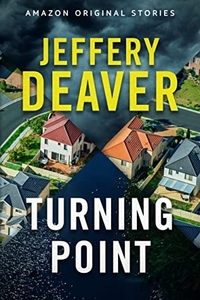
Turning Point by Jeffery Deaver

Published digitally by Amazon Original Stories on January 19, 2021

Coming in at more than 60 pages, “Turning Point” is a longish short story in Amazon’s series of original stories. The story is a standalone that features none of Jeffery Deaver’s popular series characters.

A serial killer has murdered three women. After he tortures his victims, he leaves a Russian nesting doll at the scene of his crimes. Capturing the killer requires a creative plan that I won’t spoil.

The most interesting of the story’s characters is a fellow named Michael Stendhal. Michael is a jerk and a bully. Even apart from his criminal tendencies, he’s just mean. He goes on a date and belittles the woman who meets him for leaving her daughter home alone. In a dispute over who got to a taxi first, he asks a woman why she dresses her daughter like a slut, a strategy that gets him the cab when the daughter flees in tears. Michael is not a people person but he likes himself just fine.

A police detective named Ernest Neville seems to be playing a collateral role in the story as he searches for the killer, even after he finds a nesting doll on his property. Yet roles played by characters evolve as the story evolves. Multiple characters are not what they seem to be.

The character with whom the reader spends the most time is unlikable, but that doesn't detract from the story's pleasure. With a tongue-in-cheek attitude, the story asks whether assholes play a useful role in society. Deaver knows that the answer is either “no” or “rarely,” although assholes will likely have a different answer. Given the prevalence of self-satisfied jerks in America, the question is timely. Jerks do seem to think they’re serving a useful purpose by annoying the crap out of everyone they meet.

The story takes multiple twists, using misdirection that makes it difficult for the reader to guess what will happen next. Crime fiction fans have grown accustomed to Deaver’s ability to create intriguing characters and surprising plots. “Turning Point,” while not as weighty as Deaver’s longer work, accomplishes those ends.

RECOMMENDED

Monday
May112020

The Goodbye Man by Jeffery Deaver

Published by G.P. Putnam's Sons on May 12, 2020

Colter Shaw is a reward hunter, as opposed to a bounty hunter, but of course he turns down or gives away rewards because he’s just so darn good. Shaw starts the novel by tracking down a young man who has disappeared with a friend after being accused of participating in a shooting. Of course, the accusations are false, but before Shaw can prove their innocence, the young man’s friend commits suicide for no apparent reason.

Jeffery Deaver picks easy targets in The Goodbye Man and magnifies their evil to make sure the reader loathes them. Before the suicide, local law enforcement agents decide to murder the two young men simply because they are undesirable outsiders. They practically salivate at the idea of killing them. There are plenty of people in law enforcement who don’t deserve a badge, but killer cops aren’t usually as depraved as the ones depicted in the novel. Sure, Shaw is a good guy because he doesn't think that cops should commit murder, but there's a certain lack of subtlety in portraying villains as the worst people a reader can imagine.

To get to the bottom of the suicide, Shaw travels to the young man’s destination, which turns out to be a cult called The Osiris Foundation. Nobody likes cults, making it another easy target. Its founder, Master Eli, is David Koresh, Warren Jeffs, and Jim Jones rolled into one. Deaver wraps up the very worst tendencies of cults into one neat package, giving Shaw no choice but to infiltrate and destroy it.

That nobody else has discovered the cult’s malevolence is even more difficult to believe than the malevolence itself. Deaver tells us that the cult is secretive, but it needs members to sustain itself, so it can’t be all that secretive. Yet nobody notices that people who join the cult are victimized in ways that would surely be noticed by the outside world? I didn’t buy it.

Nor did I think that anyone would view Master Eli as anything but a joke. In just three weeks, his followers are so devoted to him that they are willing to sacrifice themselves because they believe his silly promise of a better future. All cult leaders are con men, but they succeed because they have charismatic appeal. Deaver didn’t make me believe that anyone would believe a single preposterous word that Eli utters.

On two occasions, cult enforcers physically abuse people where Shaw can watch. A cult that is trying to convince members that it offers the path to peace and serenity would hardly engage in such public displays of violence. Yeah, Shaw is not making his presence obvious on either occasion, but how convenient it is that Shaw happens to be in a place where he can see the violence going down? Writers who rely on improbable coincidence to advance a plot need to try harder.

Oh, and for all the security measures the cult takes, there is an unguarded gate that Shaw happens to find, giving himself easy egress and ingress to the compound. Too convenient? Yeah, just a bit.

Some aspects of The Goodbye Man are interesting, or at least amusing. Master Eli exaggerates his accomplishments, talks about fake news, encourages his followers to chant slogans and attack anyone who questions him, and is a “raging narcissist.” He reminded me quite a lot of Master Donald, on whom I am guessing he was modeled. Shaw pretty quickly sees through the Foundation’s self-help scam, but one of the therapists who engages Shaw gets him to take a deep dive into his real issues (involving his unresolved feelings of guilt about his absent brother), adding a moment of unexpected depth to a fairly simple plot. None of that is quite enough to earn a recommendation.

I expected The Goodbye Man to earn a guarded recommendation until the final chapters — maybe the last quarter of the book — went it rolled completely off the rails. Parts of the story that are supposed to be touching are too contrived to have an emotional impact. Apart from a weak plot, Shaw has developed all the personality of a comatose actuary. Shaw's habit of following his father’s tedious rules and assigning arbitrary percentages of success to his action plans are supposed to be interesting traits, but they only makes him annoying.

About half of last 50 pages weave in an ongoing story about a conspiracy that Shaw’s father was trying to unravel. That storyline began in the first novel and will probably unfold over several books. The conspiracy seems almost as ludicrous as the Osiris Foundation’s scheme. It doesn’t encourage me to believe that the next installments will be worth reading. That’s disappointing, since I have generally enjoyed Deaver’s Lincoln Rhyme books.

Deaver performs all the thriller writer tricks to make the novel seem to move quickly — short chapters, lots of white space — but the book loses momentum as it nears the end. I enjoyed the first Shaw novel (The Never Game) but this one is a step down.

NOT RECOMMENDED

Monday
May132019

The Never Game by Jeffery Deaver

Published by G.P. Putnam's Sons on May 14, 2019

It isn’t often that thriller writers come up with a fresh premise. I don’t know if The Never Game is based on an original concept, but it’s new to me. A role-playing video game called The Whispering Man requires players to escape their captivity. They are initially given five objects to help them escape; they then search for more objects, trade with other players, or kill other players, depending on their strategy. In the real world, someone is kidnapping people, apparently at random, and supplying them with five objects. The involuntary players either escape and survive or not. The victims are left in places that correspond to different levels of the game. As improbable criminal schemes go, this one is fresher and more entertaining than most. The idea of forcing someone to play a game isn’t new, but forcing people into the real-world version of a video role-playing game is something I haven’t seen before.

The protagonist of this new series, Colter Shaw, travels around in his RV collecting rewards. The Never Game begins with a confrontation between Shaw and a fellow with a Molotov cocktail, but soon shifts to Shaw’s agreement to find information leading to the location of a missing girl named Phoebe, for which her father will pay $10,000. She was last seen riding her bicycle in Santa Clara County, California, where Shaw begins his hunt.

Phoebe’s kidnapping is eventually followed by another, leading Shaw (with the assistance of people who know more than he does about video games) to conclude that the kidnapper is following the progression of The Whispering Man. Shaw spends some of his time learning (and thus educating the reader) about the world of gaming and different perspectives on the players who inhabit it. One of his teachers is an attractive young woman named Maddie, adding a bit of sexual tension (or just sex) to the plot.

Shaw is the kind of restless loner who is familiar to thriller fans. He grew up on a large compound adjacent to forested public lands. Only the strangest of people live in compounds, but Shaw is only moderately damaged by his childhood. His father taught him many rules, all of which begin with “Never.” Shaw also learned how to track, a skill that led to his current occupation as a finder. Shaw’s backstory is developed intermittently as the novel progresses. Suffice it to say that he learned how to handle himself in the wilderness, armed or unarmed, and that he is still unraveling a mystery concerning his father. Shaw doesn’t pretend to be a skilled fighter, which makes him a refreshing thriller protagonist.

A clever and timely twist at the end has Shaw and the reader rethinking the killer’s motivation. I’m not always a fan of Deaver’s novels — I like his Lincoln Rhyme books more than the Kathryn Dance series — but he pushes all the right buttons in The Never Game. The story is smart, it moves quickly without devolving into mindless action, and the protagonist has a bit of depth.

Shaw’s backstory gives him reason to investigate a formative incident from his past, while various encounters during the novel set up a mystery that could unfold over the course of several books. The concept of collecting rewards for finding missing persons gives Deaver room to take this series in any number of directions, and the last chapter sets up alternative scenarios for Shaw’s next mission. If The Never Game is any indication, crime novel fans who like to follow a protagonist throgh a series of books should consider adding Shaw novels to their book-buying lists.

RECOMMENDED