The Tzer Island book blog features book reviews written by TChris, the blog's founder.  I hope the blog will help readers discover good books and avoid bad books.  I am a reader, not a book publicist.  This blog does not exist to promote particular books, authors, or publishers.  I therefore do not participate in "virtual book tours" or conduct author interviews.  You will find no contests or giveaways here.

The blog's nonexclusive focus is on literary/mainstream fiction, thriller/crime/spy novels, and science fiction.  While the reviews cover books old and new, in and out of print, the blog does try to direct attention to books that have been recently published.  Reviews of new (or newly reprinted) books generally appear every Monday, Wednesday, and Friday.  Reviews of older books appear on occasional weekends.  Readers are invited and encouraged to comment.  See About Tzer Island for more information about this blog, its categorization of reviews, and its rating system.

Monday
Mar252019

Cheer Up, Mr. Widdicombe by Evan James

Published by Atria Books on March 26, 2019

The Widdicombe family is “a sociable clan” grappling with the “curse of success.” Its members spend their days happily bickering with each other. Carol Widdicombe presides over their summer home on Bainbridge Island, a home she desperately wants to see featured in an interior design magazine. Her husband Frank’s usual state of depression has deepened because his annual trip to France, a reunion of college friends that he views as therapeutic, has been cancelled.

Frank responds by throwing himself in to a new project, writing a disjointed self-help workbook he calls The Widdicombe Way. Chapters include “On Putting on a Few Pounds” and “The Company of Cats.” Frank’s thoughts are less than profound but all the funnier for their randomness.

Frank is a retired sports psychologist. His son Christopher is also depressed, primarily because he is not in Italy playing with his older Albanian boyfriend. Christopher is unhappy that his parents are so tolerant and loving. To market his watercolors, he must pretend that he is the victim of “disgrace and loveless rejection.” In reality, his parents accept that he is gay in the same way they accept pretty much everything.

Bradford Dearborne, a “carefree loafer,” is a guest of the Widdicombes on a trip to borrow money from his father, a coffee mogul in Seattle. His father has financed Bradford’s screenwriting efforts for a year. Bradford partied in LA but made little progress on his horror film, and his father seems unreceptive to renewing his financial support. While Bradford sulks at the Widdicombes, he finds himself quite taken by Michelle Briggs, Carol’s assistant.

Other notable characters include a self-help guru who happens to be Carol’s best friend (Gracie advocates “decorating for enlightenment” and making a home into a “creativity shrine”), a gardener named Marvelous, and a gay Dane who is Michelle’s best friend. Each character benefits from a quirky but believable personality. The narrative flits from character to character, giving each due attention without lingering long on one character’s story before landing on another.

The novel finds fertile ground for humor in America’s self-help obsession. Self-help is a popular and deserving target of ridicule in comic novels. One problem with self-help, as the book illustrates, is that it distracts from actual living. Another is that the people who dispense self-help advice often have a tenuous grip on reality. But people like to be told they are sick so that they can learn the cure — or so one of the characters believes.

While its relationship humor is not as sharp as its self-help satire, Cheer Up, Mr. Widdicombe is an amusing domestic comedy. In the tradition of literary novels that emphasize characterization at the expense of plot, the novel doesn’t have much of a story to tell or even much of a point. It ends without resolving any of the questions it raises about how life might turn out for the various characters. Bradford all but disappears; other characters hang about but are little changed from the novel’s beginning to its end. For readers who won't be put off by a story that has no resolution, the novel's value lies both in its gentle wit and in its modest insights into unconventional characters who struggle to find purpose in their charmed lives.

RECOMMENDED

Friday
Mar222019

Creation Machine by Andrew Bannister

First published in the UK in 2016; published by Tor Books on March 5, 2019

Creation Machine takes world-building to the level of galaxy-building. The Spin consists of 89 artificial worlds and a number of artificial suns that seem to have been created as a joke. As is true of all good galaxies, the fun planets are fairly lawless while the boring planets are tightly controlled. Taussich is among the planets of the Cordern, the six innermost planets at the center of the Spin. Taussich has established a five-planet protectorate controlled by the Patriarch, whose advisor/enforcer (because every dictator needs a Darth Vader) is Alameche, a sadistic and Machiavellian Head of Security who does most of the Patriarch’s thinking and all of his killing.

Taussich would like to have a greater role in the Hegemony, which dominates the worlds of the Inner Spin. The Hegemony is repressive — it doesn’t like artificial beings or artificially enhanced humans, nor is it tolerant of free thought. Its rigidity has not yet spread to Catastrophe (where a couple of planets once collided, creating from rubble the Catastrophe Curve) although it is expanding its reach to the Outer Spin.

Taussich all but destroyed the protectorate’s fifth planet in order to bring it within its protective fold. Certain powerful interests took notice but decided to leave the barbarians alone until they learned that Taussich discovered an artifact on the planet it most recently plundered. The artifact may be an apocalyptic weapon, although the humans on Taussich have no clue what it is. A mechanistic representative of the powerful interests, Machiavellian in its own right, comes to Taussich to assert dominion over the artifact.

A good bit of work and imagination went into the novel’s background. I’ve only described the basics, but there are enough planets and aliens here to power a television series for several seasons. Of course, a novel needs plot and characters in addition to ideas and atmosphere, something certain sf writers tend to forget. Fortunately, Andrew Bannister delivers an entertaining story with a nice mix of likable and despicable characters.

Fleare Haas begins the novel as a prisoner, one of the few survivors of a group that challenged the Hegemony. Fleare’s father is a rich bastard who has a powerful position in the Hegemony. Fleare rebelled against her evil father — hence her imprisonment. Fortunately, Fleare’s former lover Muz is still alive. Perhaps less fortunately, Muz now exists as a cloud of nano-machines. He’s handy in a fight, but maybe not a girl’s dream date.

There are plenty of fights and chases and adventures as Fleare reconnects with a couple more members of the old rebel group on an anarchistic planet, then tries to stay free and alive. Eventually the story shifts away from Fleare and refocuses on Alameche’s scheming.

During the late chapters that take place on Taussich, we learn something about the nature of the artifact. Not coincidentally, we also learn something about why the novel is titled Creation Machine. There is clearly more to learn, and the path to discovery will presumably extend into the rest of Bannister’s Spin Trilogy. Those have been published in the UK and I’m guessing Tor will soon market them in the US.

As the first novel in a trilogy, the story doesn’t really end, although a few of the characters do. Some of the dangling threads are perplexing, as is the nature of one of its surviving characters. The novel avoids a cliffhanger but the reader will need to move on to the next book as the first one cannot be read as a self-contained story. I don’t mind doing that because it would be a shame to waste all that galaxy building on a single novel.

The story’s political intrigue is fairly standard for science fiction (or world history texts, for that matter) but the greater intrigue lies in the artifact. We get only a glimmer of its nature and purpose, enough of a teaser to invite interest in a full development of the concept. Given the Bannister’s fluid writing style and his ability to integrate detailed story elements with fast-paced action, I look forward to seeing what happens next.

RECOMMENDED

Wednesday
Mar202019

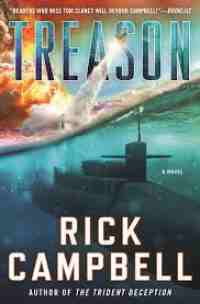
Treason by Rick Campbell

Published by St. Martin's Press on March 19, 2019

Treason is the fifth novel in Rick Campbell’s Trident Deception series. The only other one I’ve read is the third, Ice Station Nautilus. I enjoyed that one because I’m a sucker for submarine novels. Happily, there are submarines in Treason, although submarine fans will need to wait until Chapter 12 to voyage below the surface of the sea. The two series entries I’ve read share some central characters, but can easily be read as stand-alone novels.

The focus is on National Security Advisor Christine O’Connor, with whom Russia’s post-Putin president would like to have an affair. Since Christine killed some important Russians in an earlier novel, the president’s libidinous intent is unsettling to other members of the Russian government, who believe that justice requires Christine to be assassinated before the president has a chance to get her into bed. Fortunately for Christine, they aren’t the president. Unfortunately for Christine, sleeping with Russia’s president does not occupy a position on her bucket list, and she has been invited to his summer home for what the president hopes will be a tryst. What’s a National Security Advisor to do? Détente between the sheets?

Christine is still peeved at a SEAL named Jake Harrison because, after she twice rejected his proposals, he promised to wait for her, then stopped waiting after ten years. Don’t promises like that come with an automatic expiration date? Before the novel is over, Christine will have another unreasonable reason to be angry with Harrison.

Before that soap opera unfolds, a group of Russian military leaders plot an unsanctioned act involving a secret weapon that, they believe, will cripple NATO and allow Russia to reclaim Ukraine, the Baltic States, and half of Poland. Their success requires them to get Russia’s president out of the way until he is on board with the plot or dead, whichever is most convenient. Unfortunately for Christine, she has a front row view of the coup. The coincidence that once again places Christine at the heart of the action is a bit contrived and the secret weapon isn’t all that believable, but thrillers often require the suspension of disbelief, so I rolled with it.

Other aspects of Treason are also a bit of a stretch — particularly a SEAL invasion of Russia's Ministry of Defense, which didn’t strike me as even remotely plausible — but after the initial set-up, the novel sustains such a rapid pace that the reader won’t have time to wonder whether the story is credible. Sometimes plausibility gives way to enjoying the action on multiple fronts. Christine and Russia’s president try to stay a step ahead of the Russian plotters who want to kill them; the American president and his team try to figure out why America’s military technology has fallen under Russian control; and the submarine sends a Navy SEAL team into Russia on a rescue mission before engaging in an undersea battle against a bunch of Russian subs. Fun stuff.

Campbell doesn’t put much effort into characterization, but Treason works well as a military action novel. Even with SEALs running around, the emphasis isn’t on tough guys being tough. A female protagonist who isn’t in the military and who manages to be tough without having a tough guy persona makes the story more interesting than testosterone-laden action stories. Given my fascination with submarine novels, I particularly enjoyed the detailed submarine chapters, but I recommend Treason to anyone who enjoys military thrillers or fast moving action stories.

RECOMMENDED

Monday
Mar182019

Run Away by Harlan Coben

Published by Grand Central Publishing on March 19, 2019

Simon Greene, a wealth manager, learns that his estranged daughter Paige is playing a guitar for tips in Central Park. Paige is a junkie who has been missing for some time. Simon tries to rescue her, but her boyfriend, Aaron Corval, intervenes. Simon is arrested after punching Aaron and naturally, the video goes viral. A few months later, after Aaron is murdered, Simon and his wife go looking for Paige again.

While that’s happening, a private detective in Chicago named Elena Ramirez is looking for a young man named Henry Thorpe who has also gone missing. Digital messages suggest that Henry was in touch with Paige. Not much time passes before Simon and Elena are working together.

Meanwhile, two orphans named Dee Dee and Ash are roaming around the country doing contract killings. Dee Dee belongs to a cult and therefore claims to know the Truth. Ash loves her but thinks she’s crazy. Maybe she is, but Harlan Coben makes her quite rational as she explains her approach to religion. Dee Dee notes that every follower of a religion (whether or not it is branded as a cult) picks and chooses the religious doctrines they want to obey while rejecting parts of the same religion that seem inconvenient or wrong, and nearly every religion is a profitable business for its leadership. Dee Dee accepts the cult because she accepts those two propositions, following the teachings she likes in the hope that she will obtain a benefit.

Dee Dee is a killer, but she’s more pleasant than most fictional murderers. The plot invites the reader to wonder why Dee Dee and Ash are killing orphans and how Paige’s disappearance fits within the mystery that Simon and Elena are trying to solve.

I generally prefer Coben’s Myron Bolitar novels to his stand-alone books, and that holds true of Run Away. Coben is reliable in that he always writes with pace and creates believable characters. Simon and his family are believable but boring. Dee Dee and Ash are more interesting, but the novel’s best character is an older fellow named Cornelius, who believes that when the rare opportunity to be a hero arises, it is his duty to step up. Unfortunately, Cornelius plays only a limited role.

The story isn’t particularly original. Like some other Coben stand-alone novels, I had the sense that Coben phoned it in. The climactic scene relies on a character coming out of nowhere to save the day. The ending contains one big surprise but the final reveal isn’t surprising at all. Still, Coben’s storytelling skills allow him to phone in very readable novels. Run Away doesn’t tell a great story, but it has enough good moments to make it worth a reader’s time.

RECOMMENDED

Friday
Mar152019

Fall Back Down When I Die by Joe Wilkins

Published by Little, Brown and Company on March 12, 2019

Fall Back Down When I Die takes place in and near the Bull Mountains in Montana. It follows three primary characters who connect to each other in ways that become clear by the novel’s midpoint.

Vern is determined to live in the mountains as a free man after committing a crime. He tells his story in the form of a letter to his son. Most of Vern’s letters are rants about the perceived injustice that has been (or will be) done to him because of his insistence that he had the right to do as he pleased on his own land.

At some point after Wendell Newman becomes a young adult, his mother dies, leaving him a trailer and a mortgage on their mountain farmland. A social worker places a seven-year-old named Rowdy Burns with Wendell because Rowdy’s mother Lacy is Wendell’s cousin and was like a sister to him before she became a drug addict and then a prisoner. Rowdy was left alone in Lacy’s apartment for a week before social services took custody of him. Rowdy has developmental and behavioral issues that Wendell isn’t well equipped to handle, but he’s willing to do his best because he knows what it means to be neglected.

Gillian Houlton is a widow; her daughter Maddy is a high school senior. Gillian is an assistant principal in a town that consists of churches, saloons, and empty storefronts. She sees local kids growing up in rural poverty, living off rural welfare (farm programs, government grazing leases), joining self-proclaimed militias and White Identity movements, doing willfully stupid things that land them in jail or lead to an early death, proudly eschewing education and voting against their own interests. The principal, on the other hand, would rather sacrifice a kid than make redneck parents mad, because they might begin homeschooling and the school cannot sustain a significant loss of pupils.

Gillian’s husband, a game warden, was the victim of Bull Mountains violence a dozen years earlier. Gillian is sick of violent and ignorant men who believe they have the moral right to violate the law without considering the consequences to their families, to the environment, or to future generations. She sees eastern Montana (other than Billings) as “a sinkhole for taxpayer dollars, a sick sinkhole of environmental degradation, lack of education, liquor, methamphetamine, and broken families” while working Montanans who value education spend their time trying to clean up the mess. As a teacher, she’s frustrated with parents who condemn their children to a lifetime of ignorance and squalor. Anyone who gains an appreciation of the rest of world is condemned as “forgetting where they came from.”

Fall Back Down When I Die exposes the ignorant selfishness of people who think they are entitled by land ownership and mistaken notions of personal freedom to disregard laws that apply equally to every member of society. Yet the novel is not a political diatribe. Regardless of the merit that land use regulations have, they can make life for difficult for people whose businesses are affected by them, as the novel illustrates in the form of a very decent rancher who is just trying to make a good life for his family and employees.

The novel also has a lesson to teach regarding the peril of making assumptions about people because of how or where they live. Gillian has good reason to be angry with Montanans on the far right, but the story teaches that judging people based on stereotypes leads to misjudgments, no matter where the stereotypes fall on the political spectrum. Whether the hater is on the left or right, hate destroys.

Gillian and Wendell are constructed in satisfying depth, while characters who play significant but smaller roles are surprisingly complex. Perhaps the story’s message is a bit heavy-handed, but the message is important. The plot builds tension effectively until it reaches a surprising climax. The story is sad in the way that life is often sad, and hopeful in the way that life needs to be so that decent people don’t give up on humanity.

RECOMMENDED