The Tzer Island book blog features book reviews written by TChris, the blog's founder.  I hope the blog will help readers discover good books and avoid bad books.  I am a reader, not a book publicist.  This blog does not exist to promote particular books, authors, or publishers.  I therefore do not participate in "virtual book tours" or conduct author interviews.  You will find no contests or giveaways here.

The blog's nonexclusive focus is on literary/mainstream fiction, thriller/crime/spy novels, and science fiction.  While the reviews cover books old and new, in and out of print, the blog does try to direct attention to books that have been recently published.  Reviews of new (or newly reprinted) books generally appear every Monday, Wednesday, and Friday.  Reviews of older books appear on occasional weekends.  Readers are invited and encouraged to comment.  See About Tzer Island for more information about this blog, its categorization of reviews, and its rating system.

Entries in France (27)

Thursday
Apr162026

Small Boat by Vincent Delecroix

Published in France in 2023; published in translatino by Mariner Books on April 21, 2026

Small Boat is a novel of conscience. A woman lives with her guilt by denying her wrongdoing, by claiming — as so many people do when they make offensive or insensitive comments about members of groups to which they do not belong — that she was only saying what everyone else was thinking. But deep within her shriveled heart, she knows she was wrong — or does she?

The story is built upon a real-world event. In November 2021, migrants on an overcrowded rubber dinghy were attempting to cross the English Channel from France to England when their motor failed. As the dinghy began to take on water, a migrant made frantic calls to the rescue services of the British coastguard and the French Navy.

After some jurisdictional squabbling about whether the migrants were in French or British waters, it became clear that no British vessel was close enough to rescue the migrants. A French trawler spotted the dinghy and asked the dispatcher what it should do, but the trawler’s crew were told that a French vessel was on the way. The French Navy dispatcher, however, declined to send help and seemed annoyed that the migrants kept pleading for rescue.

Recordings reveal that the dispatcher told the migrants “Don’t you get it? You won’t be saved.” When a migrant protested “I’m up to my feet in water,” the dispatcher answered, “It wasn’t me who told you to leave.” Nobody rescued the migrants. In the days that followed, 27 bodies were recovered, most of them Iraqi Kurds. They would have been saved, but for the dispatcher’s obstinate refusal to act.

The first and last parts of the novel are narrated by a fictional version of the French dispatcher. In the first part, the dispatcher is questioned by police officers who are investigating her negligent (or perhaps willful) failure to send a rescue vessel to help the migrants. The dispatcher offers multiple excuses — she claims to have believed that the dinghy was in British waters or soon would be — and fails to take responsibility for her actions.

The dispatcher’s job is to save people, not judge them, but she has no patience with a police investigator who seems to be judging her. The dispatcher doesn’t believe it was her responsibility to “weep, weep for their wretchedness and the drowning of their dreams, weep with them and for them, which most certainly would not have saved them, but at least, apparently, would have saved me, would have saved my soul.”

The novel’s second part is a brief but horrifying third-person account of the passengers on the dinghy. The focus is on the young man whose cellphone still worked, who repeatedly called both England and France for help before he and the raft sank into the water, the initial event in his slow journey to death.

The last section reveals more of the dispatcher’s inner thoughts. She finds herself metaphorically drowning as she struggles to justify her inaction. She carries a resentment toward the world that seems to stem in part from her failed relationship with her daughter’s father, a white French nationalist. “When Eric left, when I had to ask him to leave and in the end he actually did, and I found myself alone with my daughter, and I couldn’t manage all alone with my little girl, and I was going under, who came to my aid, who tried to save me? No one.” She is entirely self-absorbed and thus has no time for the problems of migrants.

The dispatcher also believes that her interrogator judges her so she can feel better about herself. In the dispatcher's view, the interrogator wanted her to send help “so humanity could be reassured about itself, so humanity need not doubt its humanity, and so she would not have to fear what she’d become, that is to say, a woman like me, like the one I’ve become.”

The narrator also wonders whether there is any point to her job: “Why save one, ten, twenty; it’s all the same, since you can’t save them all. There is always one left. … And the one that you save will perish tomorrow or the day after, here or elsewhere. So why bother?” She is still in denial but is clearly haunted by thoughts (perhaps ghosts) of the dead migrants. “The night is full of voices calling, mingling with the sound of the waves which do not cradle me. All these voices like waves above the waves. Voices of men, women, cries, sobs, prayers and farewells. A great babbling in English, always the same words, the beseeching sea.”

Vincent Delecroix’s prose adds a lyrical quality to a powerful story. He illustrates how, in some people, self-justification overrides conscience and acceptance of responsibility. But the story also forces us to understand that every person who ignores the plight of migrants seeking refuge also shares responsibility for their fate. Small Boat is a short but intense examination of how the absence of compassion destroys lives, including the lives of those who are condemned to live with the guilt they try to suppress.

RECOMMENDED

Wednesday
Jul022025

French Windows by Antoine Laurain

First published in France in 2023; published in translation by Pushkin Press on July 1, 2025

French Windows is a different take on the murder mystery genre. Dr. J. Faber is a psychoanalyst. His new client, Nathalia Guitry, tells him that she thinks she has screwed up her life. She feels “not fully alive” and characterizes her professional life as a failure.

Nathalia is a photographer but she no longer takes photographs. “‘When you can no longer do the job you love,” she explains, “you lose interest, and you don’t love it any more.” Faber asks her about the last photograph she took and she answers that it was a photograph of a murder. The topic of murder is not raised again until the story is about to end, leaving the reader to wonder how this could be a murder mystery. The answer: it mostly isn't.

Nathalia tells Faber that she spends much of her time looking out her window. She watches the people who live in the five floors of the wing across from her. She describes what she sees as “Stories. Lives. Life.”

Faber instructs Nathalia to write a story about the occupant of the ground floor and bring it with her to their next therapy session. “A true story, or one you’ve made up, it doesn’t matter which.” They will then repeat the process for the remaining floors until she has given Faber five stories. Faber hopes that she will reveal something about herself through the stories she tells of other people.

The bulk of the novel consists of Nathalia’s stories. One explains how the occupant of a flat adopted a new identity and became a YouTube influencer, a lifestyle coach who gives relationship advice, having achieved fame with the video If All Men Are Idiots then All Women Are Fools. After the session in which Nathalia discusses that story, Faber does some research and discovers that the story is apparently true.

The next story is about a successful, overweight cartoonist who buffs up to impress a woman who ignored him in high school. The third is about a man who must choose between his cat and a child who has a cat allergy. Another is the story of a man who had a near-death experience, sold all his goods, and traveled to Scotland to visit a tower that became his obsession. The last one, about a hypnotist, finally works its way back to the photograph of a murder.

Faber’s investigations of each story glue them together. The reader learns about Faber and his relationships with his wife and daughter, as well as his interest in old skeleton (passepartout) keys. It makes sense that a psychoanalyst would have a passion for keys, given his desire to unlock the hidden thoughts of his patients.

The story might be about the destiny we unconsciously shape. In the words of Jung: “Our destiny is the external manifestation of our internal subconscious conflicts.” Faber comes to understand Jung’s meaning through his interaction with Nathalia. Perhaps the reader will, as well.

Given its almost tangential nature, the mystery would be easily spoiled by discussing the murder that Nathalia photographed. The murderer’s identity necessarily comes as a surprise, given that the reader knows nothing about the murder until late in the story. While neither the murder nor the reveal are shocking, the story’s structure is quite clever.

French Windows might not appeal to mystery fans who want their mysteries to follow a familiar formula. The novel barely qualifies as a murder mystery, but the stories of the various apartment dwellers, while not particularly mysterious, are all engaging. As is Nathalia, a beautiful woman whose features Faber cannot recall after she departs. Faber’s wife wonders whether she is real or a figment of Faber’s imagination. Whether Faber’s wife is on the right track is a question for the reader to decide.

Although French Windows is a murder mystery in name only, it succeeds as a captivating glimpse of a psychoanalyst who needs to unlock his inner self before he can understand his relationships with his family and patients. Unpeeling the story’s deceptively complex layers might be a greater challenge than solving a murder.

RECOMMENDED

Monday
Sep182023

Beyond the Door of No Return by David Diop

First published in France in 2021; published by Farrar, Straus and Giroux on September 19, 2023

Beyond the Door of No Return is a love story combined with an adventure story, set in the eighteenth century when adventures were still possible and when interracial love was often viewed as an abomination.

The story begins in the third person. Michel Adanson is old and nearing death. He made an academic career as a botanist. To the exclusion of everything else in his life, including marital happiness and a relationship with his daughter Aglaé, he has devoted himself to cataloging the various plants, shellfish, and animals he has encountered on his travels. His hope to publish a 20-volume encyclopedia of nature has been dashed, in part due to lack of interest among academic publishers.

About six months before his death, a broken femur inspires the revelation that over the course of time, Michel’s work will be forgotten, supplanted by “the eternal churn of human beings crashing over one another like waves” that would “bury him under the sands of his ancient science.” What suddenly seems important to Michel is “to figure in the memory of Aglaé as himself and not merely as some immaterial, ghostly scholar.”

To that end, Michel composes the story of an episode that shaped his life, a personal history that he has never shared. He hides the story in a desk, anticipating that Aglaé will care about him enough to decode his clue and find it. She does. The story helps her understand why her father’s last word was “Marak.”

Aglaé’s own story is that of a young woman who craved but did not receive her father’s attention. Her mother forced her into an unwise, short-lived marriage before her second husband, despite his absence of passion, gave her two children during another doomed marriage. Aglaé has come to believe that love and happiness exist only in romantic fiction. It is in this state of mind that Aglaé discovers the notebooks that contain her father’s story. I was disappointed that we do not learn more about Aglaé's reaction to the notebooks after she reads them. She is an important character until she disappears from view.

The novel’s greater focus is on the two stories that Aglaé discovers. One is Michel’s written account of his trip to Senegal when he was a young man in pursuit of botanical knowledge. Guided by Ndiak, son of the king of the Waalo, Michel hears about a revenant named Marak Sek who returned to Africa after being sold into slavery. It turns out that Marak is very much alive, not the walking dead. By coincidence or fate, Marak meets Michel after he falls ill.

The other story is Marak’s, told in the first person to Michel who recounts it in his notebooks. Marak survived two attempted rapes, escaped her confinement, was found and nurtured by a tribal healer, and has taken the healer’s place. While she does not live in her uncle’s village, she accepts the risk that he will find her and return her to the slave trader from whom she escaped. Her uncle’s reputation might be at risk if she is free to reveal his attempted incest.

Marak’s story is filled with harrowing moments. Enraptured by Marak’s beauty and fighting spirit, Michel falls in love with her. Perhaps he feels lust more than love. He denies that he is governed by desire, but the novel does little to explain what other qualities inspire Michel's love. In any event, their relationship propels the adventure story when Marak’s village turns out to be less safe than she had hoped.

Ndiak is the story’s philosopher. He talks about the “what if” moments in life that determine events. What if Michel had been taken to a different village when he fell ill? The chain of events that determined Michel’s and Marak’s lives would have been very different. Those events also change Ndiak’s life by inspiring him to understand the evil that is perpetrated when his fellow Africans sell each other into slavery.

By the end of his stay in Senegal, Michel discovers that European plants adapt nicely to Senegalese soil. Rather than enslaving Africans and exporting them to America, it would have been more profitable to pay Africans to grow sugar at home. Yet Michel knows that nobody wants to disturb the profits generated by the slave trade. Michel feels shame that he does not take an active role in clarifying the economics of slavery. He feels similar shame that, after returning to France, he did not confess his love of a Black woman. As a product of his times, Michel is not an exemplary character, but readers might appreciate his capacity for interracial love and his occasional spark of decency.

For reasons I won’t reveal, Michel’s life moves forward without Marak. The grief of loss cements his dedication to science as an alternative to heartache. He tries to forget but the novel suggests that the heart remembers what the mind chooses to ignore. Michel’s love story proves to be tragic in multiple ways, but an event near the end of his life proves that powerful memories may be suppressed but never forgotten. A work of art, a piece of music, can have “the power to reveal to ourselves our secret humanity.”

The final chapter makes clear that even if the significance of our lives and memories might be lost on others, they are nevertheless important. Michel’s story might be of no consequence to anyone but himself and perhaps Aglaé, yet the novel reminds us that listening to stories of others helps us understand our own lives. Integrating those stories into our own memories and sharing them contributes to a collective understanding of humanity. David Diop makes those points with subtlety in a story that is always interesting, sometimes exciting, and occasionally moving.

RECOMMENDED

Wednesday
Aug232023

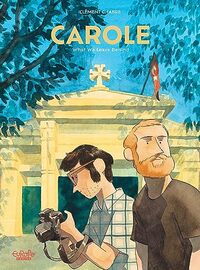
Carole by Clément C. Fabre

First published in France in 2023; published in translation by Europe Comics on August 30, 2023

For reasons he never explains, Clément’s life fell apart at the age of 27. His therapist suggested he learn more about his grandparents’ experience in Turkey. They were children during the Armenian genocide and fled after nationalists became violent in the mid-1950s. Perhaps Clement is suffering from intergenerational trauma. Perhaps his crisis is one of identity. He doesn’t feel like an Armenian. He doesn’t feel like a Turk. France is the country of his birth but he doesn’t seem to feel French.

Before his grandparents moved from Istanbul to France, they had a child named Carole who died in infancy. Clément’s grandmother later tried to locate Carole’s grave but discovered that the grave is missing. In need of a vacation and perhaps for its therapeutic value, Clément and his brother Robin decide to find Carole’s grave. Robin also wants to make the trip to further his study of history.

The brothers arrive in Istanbul during the Gezi Park protests. They search a cemetery, and then several more, taking pictures of headstones that are represented as drawings in the graphic novel. They can’t find Carole in any death registry. They visit and photograph places that were important to their grandparents: the church where they married; a court where their grandfather played basketball; an apartment building where their grandmother lived; their grandfather’s school and the place where he had his shop.

The brothers discover that Turkey is divided between nationalists who support Erdoğan and those who want the country to accommodate Kurds and Islam. Clément plans to create a graphic novel about their journey. To that end, he draws the scenery: beautiful old buildings, lovely landscapes, but also the aftermath of riots and buildings covered with graffiti. The brothers are also a bit divided, both in their willingness to try local foods (Clément finally relents and enjoys his brother’s culinary suggestions) and in their dedication to solving the mystery of Carole’s missing grave.

When the trip seems incapable of solving the mystery of the missing grave, the brothers wonder whether the trip was worthwhile. Perhaps the journey was more important than the destination. Traveling to Istanbul gives them a reason to think more carefully about their grandparents’ stories and their own ancestral identities. They don’t understand why their grandfather has nothing but fond memories about a country that slaughtered his ancestors, forced him to forget his language, and made him change his name so he would fit in with Turks. Their fascination with their grandfather’s story shortchanges their grandmother’s history. Their mother, on the other hand, seems wary of disturbing her parents with new discoveries about their past.

The story is mildly frustrating in that the facts that the brothers learn, both before and during their trip, don’t quite match the details of their grandfather’s explanation for leaving Turkey. Those discrepancies cry out for an explanation but none is forthcoming. I suppose the story is autobiographical and the author can’t explain what he doesn’t know.

Otherwise, the story is informative. Using narratives, headlines, and drawings of old photographs, the book provides a history lesson of Turkish nationalism and its impact on Armenians and Greeks. At times, the story seems like it is told by a relative who is showing slides of a family vacation (although these days, I suppose slides have been replaced by digital photos or videos that are displayed on the family’s widescreen TV). The travelogue might be more meaningful to the person telling it than to the audience.

The art and coloring are effective but familiar. Had Carole followed a mystery to a solution, it would have been a more gripping story. On the other hand, it is packed with important information about a part of the world that is probably a mystery to most Americans. For that reason, Carole is worth an inquisitive reader’s time.

RECOMMENDED

Monday
Sep272021

Dog Island by Philippe Claudel

Published in France in 2018; published in translation by Little, Brown and Company on August 10, 2021

The narrator of Dog Island tells us that the story “is as real as you might be. It takes place here, just as it could have happened anywhere.” The “here” to which the narrator refers is one of the Dog Islands, an imagined Mediterranean archipelago. Two of the islands form the jaw of a dog while others form its tongue and teeth, but only if you squint at a map and use your imagination. The particular Dog Island where the story takes place is sparsely inhabited, having little to recommend it to tourists, although a character known as The Mayor is negotiating with the Consortium to develop a Thermal Baths project from the island’s hot springs. He views the project as the “last opportunity for families to remain here, and their children, and their children’s children.”

A character known as The Old Woman is taking her daily stroll on a rocky beach when her dog begins to howl at the sight (or smell) of three dead bodies. The howl attracts the attention of Swordy (named for his proficiency at catching swordfish) and America (“a bachelor who produced a little wine and was something of an odd-job man”). They summon The Mayor who brings along The Doctor. The Teacher and The Priest round out the characters who know about the bodies. The Mayor assumes that the dead men, all black, were boat people who fled from a nearby African country and drowned on their journey to Europe. The Teacher is skeptical of that theory and in any event wants to summon the police from the mainland. The Mayor, fearing that adverse publicity will doom the Thermal Baths project, bullies the other characters into disposing of the bodies quietly.

The story takes an even stranger turn when The Teacher takes it upon himself to experiment by acquiring a boat and tossing dummies into the ocean at various points to see where the currents will take them. The Mayor, unhappy with the results of the experiment, devises a scheme to silence The Teacher. The scheme coincides with the arrival on the island of The Superintendent, who might want to investigate the bodies or The Teacher if he isn't pursuing some toher agenda. We eventually learn why the dead men died and how they are connected to the island.

Dog Island is a modern prose version of a morality play. The characters represent virtues or vices. They are identified by title rather than names because their individuality is less important than what they represent — greed, weakness, indifference, or (in the case of The Teacher) rectitude. The characters are presented with a choice between good and evil and, when they make the wrong choice, the island as a whole is punished, almost as if it has become cursed. A foul odor covers the island, growing worse by the day, while the inhabitants begin to live a strained life, losing “not so much the will to live, as their love and hope in life. All this was like a stain on a piece of clothing, on clothing that one had enjoyed wearing.”

Some of the characters are amusingly quirky (the Priest has befriended bees that follow him everywhere), as is much of the dialog. The story becomes increasingly dark but a dark ending is needed to teach the novel’s lesson. Like a morality play, the lesson is superficially simple, although in this postmodern world, it is also a bit ambiguous. I think it has something to do with women high jumpers who “attempt, in graceful and sensuous arched movements, to topple over death in order to enjoy life.” Readers who can figure out what that means, and those who appreciate the sentiment if not the meaning (I’m in that group), might find Dog Island to be a book worth reading.

RECOMMENDED