The Tzer Island book blog features book reviews written by TChris, the blog's founder.  I hope the blog will help readers discover good books and avoid bad books.  I am a reader, not a book publicist.  This blog does not exist to promote particular books, authors, or publishers.  I therefore do not participate in "virtual book tours" or conduct author interviews.  You will find no contests or giveaways here.

The blog's nonexclusive focus is on literary/mainstream fiction, thriller/crime/spy novels, and science fiction.  While the reviews cover books old and new, in and out of print, the blog does try to direct attention to books that have been recently published.  Reviews of new (or newly reprinted) books generally appear every Monday, Wednesday, and Friday.  Reviews of older books appear on occasional weekends.  Readers are invited and encouraged to comment.  See About Tzer Island for more information about this blog, its categorization of reviews, and its rating system.

Entries in Walter Mosley (12)

Wednesday
Sep122018

John Woman by Walter Mosley

Published by Atlantic Monthly Press on September 4, 2018

In John Woman, Walter Mosley again proves why his inclusion in my list of three favorite modern crime writers is not just laminated, but anchored in cement. John Woman is a crime novel in the way that Native Son and Crime and Punishment are crime novels. The books combines a crime plot with philosophy, psychology, and Tolstoy’s view that historical truth is elusive if not impossible to discover. It is fresh and original and a masterpiece in concept and execution.

Cornelius “CC” Jones lived with his father, Herman Jones, but he learned about life from his mother’s stories about the gangsters she dated. Herman reveres the English language, suggesting he might be modeled after Mosley, whose love of language is revealed in the lovely language he uses to tell his tales. But Herman is losing his words and finds himself living in the past, robbed of the present by the creeping onset of dementia.

Herman is hospitalized when the novel begins and bedridden for the next several years. CC secretly takes over Herman’s job as a projectionist so that the paychecks will keep coming. In 1955, when CC is 16, he commits a murder and is later seduced by a female cop who (unaware of the murder) enjoys dominating him. His mother has disappeared, apparently having accompanied a mobster who fled from the law.

When the novel shifts ahead to 1974, CC had adopted the identity of John Woman to protect himself from arrest for a murder he knows will eventually be discovered. He is a professor of history at a university founded and operated by members of a new age religion, a subgroup of which is known as the Platinum Path. He teaches his students that historical truth is a mirage shaped by the political, religious, and cultural biases of historians — a view that other faculty members view as undermining history and historians.

John Woman is rooted in a murder, but it is primarily a story of decent people who treat each other decently, people who value life and who understand the importance of generosity, forgiveness, and acceptance. Their decency transcends race or religion. History is full of heroes who spend time shaping a legacy, but life is full of heroes who will never be studied by historians — the friends who sacrifice to help us get through tough times, the strangers who make an effort to be kind to another stranger, the ordinary folk who make a difference in unseen ways that nevertheless change the world.

John Woman reminds us that what we don’t know about the people society regards as historically important vastly exceeds what we do know. We know even less about all the equally important people who shaped but have been lost to history. Making that point in a lecture to the faculty nearly costs Woman his job. His freedom (and thus his life) is at risk because his history as a murderer might be discovered — but it is a history he shares with many murderers, and yet another example of undiscovered historical knowledge.

The novel’s multiple themes include: bringing courage and dignity to death, the importance of understanding history to understanding life, casting off the chains of childhood to become an adult, rejection of false certainties in favor of intellectual inquiry, the nature of fate and destiny (“our purposes are not necessarily our intentions”), the need to shape the future rather than obsessing about the unchangeable past, the possibility of rising above the limited role that society might assign to people of a particular race or origin, the empowering recognition that oppressors are victims of their own oppression, the myth of white identity, the notion that denying someone else’s past (pretending, for example, that people of an oppressed group were never oppressed) is a form of murder, the drive people feel to judge each other and how little right they have to do it. And this: “There’s no value in persecuting someone for overcoming their history in an attempt to forge a better future.”

John Woman is a surprising character — he never does the expected, and is capable of both great empathy and cold calculation, able at any moment to make either the most or the least moral choice. He likens himself to the coyote of mythology, the cunning trickster. The plot of John Woman is also surprising. For all the novel’s surprises, however, it always maintains credibility; none of the plot twists are forced.. The intersection of John’s life with the Platinum Path adds suspense, as does the question of whether John will go to prison (and perhaps be transformed into predator or prey) for the crime he committed almost two decades earlier. Still, this is a novel of ideas (“the most dangerous products of humankind”) rather than thrills, of complex moral choices rather than fights and shootouts. It might be Mosley’s best work.

HIGHLY RECOMMENDED

Wednesday
Jun082016

Charcoal Joe by Walter Mosley

Published by Doubleday on June 14, 2016

Set in 1968, Charcoal Joe is the latest chapter in the story of Easy Rawlins. Continuing a theme that began in Rose Gold, Easy’s life seems like it’s getting better. He’s started a private detective agency with Tinsford “Whisper” Natly and Saul Lynx. Things are going well with his daughter Feather. He’s planning to make his life complete by marrying the woman he loves. But Easy’s life is never easy. The question that series fans will soon ask is whether Easy will again be enveloped by the darkness that defined his life in Blonde Faith and Little Green.

Aside from the personal drama that afflicts Easy’s life, the plot of Charcoal Joe involves a job that Easy is hired to do for a friend of his deadly friend Mouse. The friend, Charcoal Joe, wants Easy to investigate the murder of two men. A young physicist named Seymour Brathwaite has been convicted of the crime. Charcoal Joe wants Easy to prove Seymour’s innocence.

During the murder investigation, Easy learns that are large sum of money has gone missing, as have some diamonds. Several unsavory characters, ranging from gangsters to a police detective, would like to find the money.

Charcoal Joe returns a number of familiar series characters, including Fearless Jones, Mouse, and Jackson Blue. Easy has assembled a makeshift family, many of whom are of dubious character, but they all take care of each other, which makes them easy to like, if not admire. Feather serves as his anchor, but keeping a lover in his life is problematic. Easy learns something new about life from every encounter with another character, and so does the reader.

Easy’s observations of life are sharpened by the dangers and petty insults that black men must endure to survive in 1960s Los Angeles. His is a world of “dark skin, darker lives, and a slim chance of survival.” Yet it’s a changing world and Easy is hopeful that the future will be better, for the sake of Feather and other members of the next generation if not himself. Then as today, the changes are arriving at a snail’s pace, leaving Easy at once impatient and grateful.

If only for the brightness of his prose and the clarity of the images he evokes, Walter Mosley is always a joy to read. The plot of Charcoal Joe is intricate but never padded or confusing. But it is the depth of Mosley’s exploration of his characters that puts him in the top ranks of crime writers. Danger forces Mosley “to appreciate life; to understand its frailty, transience, and its incalculable value,” but the burden of history forces Mosley to understand himself, or at least to try.

RECOMMENDED

Monday
May182015

And Sometimes I Wonder About You by Walter Mosley

Published by Doubleday on May 12, 2015

Walter Mosley has a unique ability to see the uncommon in common people, to perceive the humanity to which inhuman circumstances give birth. His characters are damaged and betrayed. They have been abused and they have been abusive. They often live on the fringes of society, yet they retain their dignity, their wisdom, and their strength. They reinvent themselves every day because that's what life is -- a process of reinvention. Few writers convey that as well as Mosley.

When a beautiful woman walks into Leonid McGill's life (or, at any rate, sits next to him on the train), he knows he is in for trouble. Five minutes later, Marella Herzog owes him $1,500, his fee for protecting her from an attacker who was supposedly sent by her former fiancé. Throughout And Sometimes I Wonder About You, McGill ruminates about the powerful women who dominate his life, including the wife who is receiving convalescent care, the dissatisfied part-time lover, the secretary who is finding ways to recover from a horrific childhood, and now Marella.

Also playing a vital role in the story is McGill's son Twill, who has taken on a private investigation of his own. Of course, his activities cause problems for McGill. And then there's Hiram Stent, a vagrant whose case McGill turns down until, inevitably, his sense of justice compels him to look into Hiram's problem by finding a missing woman. In the time-honored tradition of PI fiction, McGill is soon working for free, because helping those in need is the right thing to do. Before the end of the novel, McGill's sense of justice has made him the target of three groups of people who want to kill him. In other words, a typical day in McGill's life.

The family element -- not just with Twill, but also with McGill's absent father, whose absence ends in this novel -- is just as strong as the larger plot threads. As he so often does with consummate skill, Mosley weaves it all together to create a tight, fast-moving story that works as a thriller, as a family drama, as an unconventional love story, and as a psychological portrait of a man who is struggling to come to terms with his past and to invent a better future.

RECOMMENDED

Monday
Sep292014

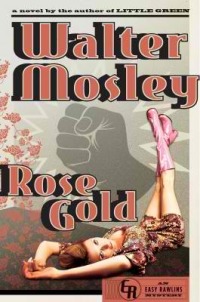
Rose Gold by Walter Mosley

Published by Doubleday on September 23, 2014

Easy Rawlins has lost interest in being a private detective (not surprising, given his loss of interest in life that recent novels chronicle) but his daughter has a chance to go to an expensive private school so he can't turn down a lucrative offer to investigate the disappearance and potential kidnapping of Rosemary Goldsmith, the daughter of a prominent weapons manufacturer. The mayor and the chief of police want Rawlins on the case and give him little opportunity to turn it down despite Easy's uneasy feeling about it. They need Rawlins because he's black. They believe his race will give him access to Bob Mantle, a black boxer-turned-revolutionary who has been seen with Rosemary in Los Angeles.

There are, of course, additional complications to the assignment that become apparent only after Easy's work is well underway. Patty Hearst echoes in the story, as do other events from the time in which the novel is set. Along the way Easy does a favor for his cop friend, Melvin Suggs, who is experiencing difficulties of his own. Several other series regulars return in small supporting roles.

Walter Mosely always tells a good story. This isn't the most compelling plot in the Easy Rawlins series but it is credible and entertaining. There are so many other things to like about a Mosely novel, however, that the plot often takes a back seat. Easy always peppers his first-person narrative with observations about the state of the nation and the changing world, a world that cannot change fast enough to suit him. As always, Easy's observations of racial injustice are pointed and personal. Easy is always a half step away from being beaten, murdered, or jailed because of his skin color. In his world, race is more likely than guilt or innocence to determine who will be arrested and punished.

At the same time, Rose Gold, like the other novels in the Easy Rawlins series, emphasizes the importance of family and friendships as a refuge from racism. Easy is renewed and restored by the insights he gains during his investigation, a welcome change from the darkness he's experienced in the last couple of novels. Even without the engaging characters, poignant moments, and sharp prose, Easy's renewal would be reason enough for an Easy Rawlins fan -- which I am -- to embrace Rose Gold.

RECOMMENDED

Friday
Aug082014

Jack Strong: A Story of Life after Life by Walter Mosley

Published digitally by Open Road Media on July 29, 2014

"Jack Strong" is a short story that is available for purchase in a digital version. This blog usually reviews books, but is making an exception for this story because (A) it is written as if it is the first in a series and (B) the blog is a fan of Walter Mosley.

As a general rule, I like Walter Mosley's crime fiction more than his science fiction, but anything he writes is certain to be literate and thought-provoking. The short story "Jack Strong" is no exception.

A man awakens in Las Vegas with conflicting memories. He recalls being a male pit boss, a female stripper, an old man at a bus stop, an obese woman playing slot machines. He notices that he has white male hands except for one black finger and one young woman's finger. He looks in a mirror and sees that he is a patchwork of skin tones, with different eye colors and varying colors of hair on different parts of his body. He is, figuratively and perhaps literally, Everyman -- and Everywoman, penis notwithstanding -- "an agglomeration of potentials on one side and personalities on the other." His driver's license says he is Jack Strong.

Momentarily settling into the personality of Lance Richards, Strong finds Richards' past catching up with him when he enters the casino Richards once managed. Fortunately, Strong is strong and at least one of his personalities is a skilled fighter. The violence that follows triggers a vigorous debate among his various selves -- some virtuous, some shady, some religious, some hedonistic -- about the morality and the consequences of his actions.

While all of the people residing in Strong's head are dead, they are capable of learning and changing. Working together, considering issues jointly, they make Strong a better person than some of his more nefarious identities would be if left to their own devices. Perhaps Mosley's point is that we are all influenced by many people over the course of our lives, and that we benefit from listening to their collective wisdom. Or perhaps his point is that we are all a complex swirl of good and bad and that we need to make choices that overcome our darker impulses.

The concept of multiple identities inhabiting a single individual has been done before and nothing much here is new. How Jack Strong came to exist is never explained, which I count as a mild weakness in the story. "Jack Strong" lacks the depth and emotional resonance of Mosley's best work, but you'd expect that in a short story. I still prefer the complexity of Mosley's crime fiction, but the characters are appealing and the plot, while a bit thin, is enjoyable.

RECOMMENDED