The Tzer Island book blog features book reviews written by TChris, the blog's founder.  I hope the blog will help readers discover good books and avoid bad books.  I am a reader, not a book publicist.  This blog does not exist to promote particular books, authors, or publishers.  I therefore do not participate in "virtual book tours" or conduct author interviews.  You will find no contests or giveaways here.

The blog's nonexclusive focus is on literary/mainstream fiction, thriller/crime/spy novels, and science fiction.  While the reviews cover books old and new, in and out of print, the blog does try to direct attention to books that have been recently published.  Reviews of new (or newly reprinted) books generally appear every Monday, Wednesday, and Friday.  Reviews of older books appear on occasional weekends.  Readers are invited and encouraged to comment.  See About Tzer Island for more information about this blog, its categorization of reviews, and its rating system.

Entries in Walter Mosley (12)

Wednesday
May152013

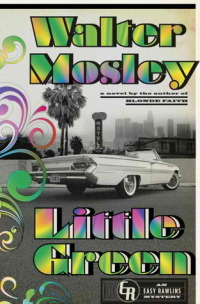
Little Green by Walter Mosley

Published by Doubleday on May 14, 2013 

The good (if not particularly surprising) news for Easy Rawlins fans is that Easy isn't dead -- he just thinks he is. A few paragraphs into the opening chapter, his revival from a coma gives birth to a new Easy Rawlins adventure. Even before he is back on his feet he has a mission: to find a missing boy named Evander Noon (a/k/a Little Green). At about the novel's midpoint, Easy takes on a second assignment, helping a friend who is the victim of a blackmail scheme.

Walter Mosley always captures the place and time in which his novels are set in high definition detail. Little Green takes place Los Angeles in 1967, a time when hippies were still a phenomenon and the Watts riots were the prism through which whites viewed blacks. Mosley builds characters who, over time, become as familiar and as real as distant friends, yet -- like real people -- they're still capable of surprising behavior. For Easy Rawlins fans, Little Green is worth reading to discover the new stage of his life that Easy has reached. This is a mellower, more optimistic Easy, one who is finally coming to terms with his difficult life, one who, having been reborn, is starting over (just as, in many senses, the country was doing).

It's a given that Mosley's dynamic prose will sweep a reader along from his first word to his last. The plot of Little Green, on the other hand, is less engrossing than Mosley has delivered on his better days. The story moves at a steady pace but it never soars. There are so many backstories in play that they tend to overshadow the central plot. The voodoo medicine that keeps Rawlins going is a silly distraction. Yet Mosley has always been a chronicler of the human condition, and if the plot is unexciting, it nonetheless has revelatory moments that illuminate the darkness within his characters, as well as their struggles to overcome it. Little Green is ultimately a story about a changing world, one that offers more hope than despair. Viewed in that light, the novel is a modest success.

RECOMMENDED
Wednesday
Mar162011

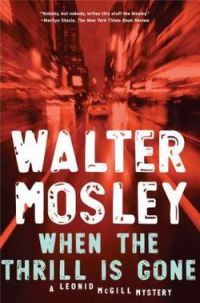
When the Thrill Is Gone by Walter Mosley

Published by Riverhead on March 8, 2011

A woman who claims to be Cyril Tyler's wife tells private detective Leonid McGill that her wealthy husband is responsible for the deaths of his first two wives. She wants McGill to save her from becoming his next victim. In need of money, McGill accepts the case but soon suspects that the woman is not in fact Chrystal Tyler. His attempt to resolve the mystery brings him into contact with the rich and poor, cops and thugs, captive children and corpses. Along the way his own children and other members of his unconventional family add to his angst.

Walter Mosley populates his sentences with observations as bright and multifaceted as gemstones. He's as much a philosopher as a mystery writer. Mosley describes a deceased character in When the Thrill Is Gone as "a complex thinker who worried about a pedestrian world." He might have been describing himself. Mosley understands human nature in all its wonderful variation. He writes eloquently but succinctly about love and betrayal, race and poverty, hard life and bitter death. Mosley gives depth to his characters while honing his story to its essentials, never miring the plot in wasted words. His dialog is snappy; his descriptions are vivid. Although the story moves with blazing speed, I found myself reading sentences and paragraphs two or three times, slowing the pace of my reading to savor Mosley's prose.

Mosley sprinkles effective doses of humor into the narrative. The story feels authentic, as do the characters: quirky enough to be interesting but grounded in life's daily pleasures and misfortunes. The mystery itself, including its resolution, is rather ordinary; the plot is engaging but unspectacular. The tale Mosley tells in When the Thrill Is Gone almost seems secondary to the writing itself. Its value is as a vehicle to drive the story of McGill's life, a fascinating life we glimpse over the course of a few days. The mystery of McGill is more interesting than the mystery he solves.

This is Mosley's third novel featuring Leonid McGill but the first I've read. The narrative makes repeated references to past events in McGill's life, some of which I assume were chronicled in the first two books. Not having read them didn't impair my understanding of the story Mosley tells in When the Thrill is Gone, but I suspect that reading them would have given me a deeper understanding of McGill. That's an omission I intend to rectify: Leonid McGill is an intriguing character -- a literate man who prefers the "rough-and-tumble of brutish men and their misplaced confidence" -- and I want to know him better.

McGill's father was a Marxist and although McGill seems rather apolitical, he likes to reminisce about his father's lessons, many of which pit working class heroes against corporate versions of robber barons. That might disturb those readers who don't want to read about political opinions in a mystery, or those who assume that a character's opinions necessarily reflect those of the author. Those readers might want to avoid this novel. To all other readers -- not just mystery fans but anyone who enjoys strong writing -- I recommend When the Thrill Is Gone

RECOMMENDED

Page 1 2 3