The Tzer Island book blog features book reviews written by TChris, the blog's founder.  I hope the blog will help readers discover good books and avoid bad books.  I am a reader, not a book publicist.  This blog does not exist to promote particular books, authors, or publishers.  I therefore do not participate in "virtual book tours" or conduct author interviews.  You will find no contests or giveaways here.

The blog's nonexclusive focus is on literary/mainstream fiction, thriller/crime/spy novels, and science fiction.  While the reviews cover books old and new, in and out of print, the blog does try to direct attention to books that have been recently published.  Reviews of new (or newly reprinted) books generally appear every Monday, Wednesday, and Friday.  Reviews of older books appear on occasional weekends.  Readers are invited and encouraged to comment.  See About Tzer Island for more information about this blog, its categorization of reviews, and its rating system.

Entries in George Saunders (3)

Monday
Jan262026

Vigil by George Saunders

Published by Random House on  January 27, 2026

A growing number of novels tackle climate change in scenes of a postapocalyptic future. George Saunders has never been one to follow a beaten path.  His focus is on the fate of a successful oilman who bamboozled the public by sowing doubt about climate science. In his dying hour, will the man repent or will his narcissism blind him to any understanding of the harm he caused?

The story is narrated by Jill “Doll” Blaine. Jill’s body is buried in a cemetery in Stanley, Indiana. She was happily married to Lloyd until they switched cars and she was blown up in an explosion that targeted her husband.

Jill was elevated after she died. She is tasked with comforting people in their hour of death. Her latest charge is J.K. Boone. A French ghost tells Jill that rather than comforting Boone, she should “lead him, as quickly as possible, to contrition, shame, and self-loathing.” Boone wants nothing to do with contrition because “against heavy odds, he’d lived an extraordinary life full of tremendous accomplishment and had always done his best and, in sum, had done nothing wrong, not a goddamn thing, and was leaving behind no lasting harm, zero, nada, none at all: a world better for having had him in it, period, full stop.”

Boone’s narcissism is the foundation of the novel’s humor. Boone believes he had been “more important to the lives of the people on earth during his time than the vast majority of those dead-and-buried folks had been to theirs. That was just a fact. Even if you included kings. Strange but true: he’d had more actual power than most kings of old. Someone had told him that once and he supposed it was true. What a thing.”

Boone’s thoughts are occupied by buzz words. He argues that any trivial harm his business causes to the climate is more than offset by “progress,” “growth,” and “free markets.” He feels no qualms about paying scientists to cook their research so they could claim that climate change is not influenced by the fossil fuel industry. He would “stand onstage there in front of some packed auditorium and say: Right here, signatures from seventeen thousand scientists who don’t believe the science here is rock-solid.” Scrutiny of the petition would reveal thousands of signatures of people who didn’t exist but by the time inconvenient facts were revealed, low-information citizens had cemented the belief that climate change is a hoax. Their ignorance made it possible for Boone to head off political momentum toward clean energy alternatives.

Jill encounters other ghosts as she hangs with Boone, including the pseudo-scientists he exploited and victims of fires and drought and other climate-related catastrophes who are less interested in comforting Boone than in torturing him. She takes an amusing detour to a nearby wedding but eventually returns to her duty with the self-centered oil man.  

As much as certain branches of theology suggest the importance of repentance and atonement, is it realistic to believe that a lifetime of self-deception can be overcome at the end? A reader might appreciate Vigil for the philosophical and theological questions its poses. On a different level, a reader might be amused by the offbeat story Saunders tells. Either way, this end-of-life scenario showcases Saunders’ ability to advance unique perspectives about serious issues without taking himself too seriously. Saunders is always funny and that’s a sufficient reason to breeze through Vigil.

RECOMMENDED
Friday
Apr212017

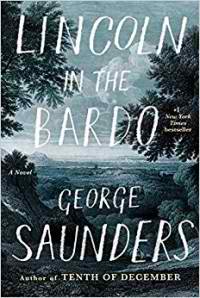
Lincoln in the Bardo by George Saunders

Published by Random House on February 14, 2017

The dead want nothing so much as to be loved. At least, that’s what we are told by the dead characters in Lincoln in the Bardo.

Much of the novel, in fact, consists of conversations held by dead characters. They watch, and comment upon, the death of Abraham Lincoln’s young son, Willie, who soon joins them.

That death and the circumstances surrounding it also the subject of scholarly commentary and contemporaneous documents (often less than scholarly) that are liberally quoted, snippets woven together to make chapters of their own. The same technique is used to construct chapters about the Civil War dead, displeasure with Lincoln’s presidency, and criticism of Lincoln’s parenting style.

The dead turn to Willie for inspiration as he tries to remain in the material world, hoping to see his father once more. Some of the (dead) characters, however, believe that Willie needs to move on, although they have not done so themselves. In fact, their inability to accept death, to accept their own deaths, just as Lincoln struggled to accept his son’s death, seems to be the point of the story. Acceptance of anything that holds us back is liberating.

Parts of the novel, particularly the dialog of spirits who criticize and backbite each other, are quite funny. In a random assembly of the deceased, sins are confessed, grievances are aired, secrets are revealed. The dead have been silent too long, and Willie’s appearance, his ability to communicate with his father, albeit briefly, gives them a chance to be heard. Or so they hope. Mostly they want one more chance to talk about themselves, just as they did before they died.

Parts of the novel, particularly Lincoln’s thoughts of his lost son, are quite moving. And parts, suggesting that bigotry and pettiness survive death, would be depressing if they were not lightened by the humor that pervades the story.

I give George Saunders credit for inventiveness. I’ve never read a work of fiction quite like Lincoln in the Bardo. The story has a worthy message about the burden of suffering that we all carry in varying degrees, and our responsibility to lighten the load of others when we can. I can’t say I was entirely captivated by the story Saunders tells, but it made me laugh, and it made me think. Any novel that consistently does those things merits a recommendation.

RECOMMENDED

Friday
Jan112013

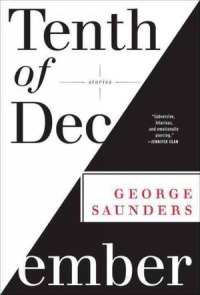
Tenth of December by George Saunders

Published by Random House on January 8, 2013

Sometimes morbid, sometimes zany, often touching, and always original, the stories collected in Tenth of December are written in a light, conversational style -- typically the kind of conversation you'd have with someone who is a little dim -- that conceals their deeper meaning. Many of the characters are like the parents or children you're glad you never had.

My favorite story, "Victory Lap," begins in the mind of Alison, a fifteen-year-old girl whose internal commentary on Eleanor Roosevelt, her ethics teacher's husband's affair, her own ignorance, and the dorkiness of Kyle Boot is, to use Alison's favorite word, awesome. The story then shifts to the scattered mind of Kyle Boot (favorite word: "gar"), whose chance of pleasing his anal-retentive father is nil and whose thoughts are filled with imaginative curses that he would never dare say out loud. When Kyle sees a man trying to kidnap Alison, he must choose between intervening and finishing his chores. The story develops a new layer of oddness when we enter the mind of the kidnapper. The ending is surprisingly sweet as humor and horror give way to karma.

The title story is another standout. Robin is a pale, blubberish boy who invents his own martial arts system (Deadly Forearms) to fight the Nethers. Eber, old and rail-thin, no longer seems real to himself. Both Robin and Eber constantly engage in silent, imagined conversations. When Robin spots Eber (thinking he may be a Nether) walking around a frozen pond, Robin makes it his heroic mission to deliver Eber's coat to him without realizing why Eber left the coat behind. The story is a bittersweet combination of humor and sorrow and inspiration.

In another close contender for my favorite story, Mikey comes "Home" from the war after a court-martial, just in time to watch his mother and her new boyfriend being evicted. The mother of his kids has taken up with a new boyfriend in his absence. His barely contained rage results in low-level violence, but his actions are inevitably greeted with the ubiquitous (and thus meaningless) phrase "Thank you for your service." None of that sounds amusing, but this serious story provokes unexpected laughter. It's better, I guess, to laugh than to cry.

I first read "Escape from Spiderhead" in The Best American Short Stories 2011. Saunders' futuristic take on chemically enhanced language and love was one of my favorite stories in that volume.

The remaining stories are all worth reading. More a vignette than a story, "Sticks" describes the way the narrator's father decorates a pole to commemorate Christmas, the Fourth of July, Veteran's Day, the Superbowl, Groundhog Day, an Earthquake in Chile, his wife's death, and, ultimately, his life. "Al Roosten" worries that noboby will bid on him at the anti-drug celebrity auction -- in fact, he worries about all sorts of things when his mind isn't buzzing with nonstop grandiose fantasies. A janitor in a medieval village is promoted to Pacing Guard after he witnesses his boss engaging in a sexual dalliance with another employee, a happy event that leads to "My Chivalric Fiasco" when he gets carried away with the role. The lives of two moms who are each doing their best, albeit in very different ways, intersect in "Puppy." Saunders takes a comical look at the power of positive thinking, in form of a memo from the boss, in "Exhortation."

Every story in Tenth of December is the product of a delightfully strange imagination, the work of an accomplished writer with a distinctive style. This is a collection of small gems that perfectly balance plot and character development. There isn't a dud in the bunch.

RECOMMENDED