The Tzer Island book blog features book reviews written by TChris, the blog's founder.  I hope the blog will help readers discover good books and avoid bad books.  I am a reader, not a book publicist.  This blog does not exist to promote particular books, authors, or publishers.  I therefore do not participate in "virtual book tours" or conduct author interviews.  You will find no contests or giveaways here.

The blog's nonexclusive focus is on literary/mainstream fiction, thriller/crime/spy novels, and science fiction.  While the reviews cover books old and new, in and out of print, the blog does try to direct attention to books that have been recently published.  Reviews of new (or newly reprinted) books generally appear every Monday, Wednesday, and Friday.  Reviews of older books appear on occasional weekends.  Readers are invited and encouraged to comment.  See About Tzer Island for more information about this blog, its categorization of reviews, and its rating system.

Entries in horror (40)

Wednesday
Apr052023

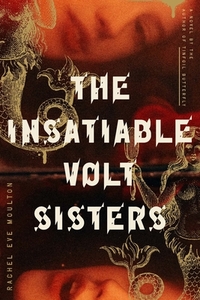
The Insatiable Volt Sisters by Rachel Eve Moulton

Published by MCD x FSG Originals on April 4, 2023

The Insatiable Volt Sisters is a literary horror story. Unless the author is Mary Shelley, I’m not sure that “literary” and “horror” belong in the same sentence. Stephen King (to whom Rachel Eve Moulton seems to pay homage by naming a character Carrie) once argued that writers either create genre fiction or literature but not both. In later years, after sharpening his writing talent, King backed away from that position, but there is some truth to the suggestion that plot-focused genre fiction isn’t easily blended with literary fiction’s focus on character and setting and deep themes. Some writers perform that trick, but Moulton sacrifices the storytelling that horror fiction demands by focusing on her literary aspirations. In the end, Moulton uses the trappings of horror fiction to dress up a domestic drama that explores feminist themes. She never manages to create the buildup of dread that is essential to a good horror story.

The plot cycles between 2000 and 1989, although the reader learns much (maybe too much) about the early history of Fowler Island in Lake Erie. We are told at least twice that Eileen and Elizabeth Fowler, sisters who developed the power to communicate with each other without speaking, built the island’s downtown and roads, as well as the Island Museum. Elizabeth married Seth Volt, who dug a quarry and built a Victorian house that islanders call Quarry Hollow. Legend has it that Seth imprisoned Elizabeth in the house, separating her from her sister. They learned to communicate by telepathy to overcome their separation.

The half-sisters Henrietta (Henri) and Beatrice (B.B.) are descendants of Seth Volt. They were born two years apart to different mothers but were often mistaken for twins, perhaps because their mothers looked so much alike. Their father James, a reclusive poet who somehow made a living, apparently had a type. After Olivia Rose vanished, James knocked up Carrie and brought her to the island as his new wife. The sisters grew up in Quarry Hollow and know it to be haunted, perhaps by Oliva Rose, but not by her alone.

Fowler Island is where depressed women go to die. “The island feasts on female sadness. It licks it up like ice cream.” Women visit the island and disappear, perhaps by jumping (voluntarily or otherwise) into the quarry, which is now filled with water. The quarry is known to the Volt sisters as the Killing Pond. Nobody seems to care about the missing women. Their bodies are never recovered so they are quickly forgotten. Moulton seems to be making a heavy-handed argument that society in general doesn’t care about women, although in most places, when someone comes across a female foot that has been detached from its body, the police at least investigate. Not on Fowler Island.

The island devil, a “great big and dripping thing with leathery fins,” lives in the Killing Pond. Perhaps bodies never surface because they are consumed by the monster, apart from the stray foot. When, on occasion, “the essential part” of the monster walks on land, it can change its shape to suit its whims. The monster’s true identity is a barely concealed secret until Moulton decides to state the obvious.

The other key character is Sonia, the curator of the island museum who helps mop up the blood and feet when women disappear. Sonia helped James raise B.B. after Olivia Rose disappeared.

For reasons that are revealed near the novel’s end, Carrie separated from James without warning, leaving the girls to fear that she had disappeared like Olivia Rose. After she returned, the girls sensed that Carrie would leave James and made drama because they feared she would only take her biological daughter with her. Their scheme to remain inseparable ends with a transformative experience for Henri. The island is indifferent to the scheme because it has plans for the Volt sisters.

Early in the novel, in a chapter that takes place in 2000, B.B. finds her father’s body, minus a part he seems to have shed. B.B. calls Henri to deliver the news. When Henri tells her mother that she will return for the funeral because B.B. needs her, Carrie reminds Henri that the island is “a magnet for trouble” and a “lighthouse for disaster.” Carrie eventually agrees to join Henri although she vows not to enter Quarry Hollow. Really, she should have known better. In any event, the Volt sisters are together once more.

The plot is all over the place. It combines a haunted house story with one of demonic possession while exploring sisterly relationships under extreme circumstances, failed marriages under extreme circumstances, and the disappearances of women who fled extreme circumstances. Themes of female despair and empowerment drive the novel. I don’t think it’s a spoiler to note that the ghosts who haunt the house are the residue of the women who died on the island. In death as in life, they are enslaved by toxic masculinity. Exactly why that is true is never addressed. It seems to be assumed that male demons feed on women because that's what men do.

The eventual show of strength displayed by the Volt sisters is a stretch, if only because their acquisition of girl power is unconvincing, even in a horror novel that demands suspension of disbelief. A late scene in which Carrie and Sonia overcome adversity by battling a devil while they’re underwater is just silly. So is the thought that ghosts of dead women urge a living woman who allies with them to “be strong” and “not to quit” until they transform the woman into “a lightning bolt of a girl.” You go, sisters! This is the kind of plot I might expect from a comic book. I just couldn’t take it seriously.

Because the novel is literary, Moulton devotes great attention to character development. Carrie and Sonia are collateral characters but they relate their thoughts in detail — Carrie’s thoughts of how it feels to be a disappearing mother, her changing feelings about James and the plan she made to escape from the island, her fear of the house and of James’ potential responsibility for the vanishing women; Sonia’s thoughts of being a maternal stand-in and the custodian of island lore. The detail slows the pace, inhibiting the fear that the novel never conjures.

Descriptions of the island monster crawling out of the goop are a bit chilling, until we realize that it’s a standard lizard monster with changeling powers. Moulton’s failure to enliven a horror story with original ideas leaves a shell that she fills with striking sentences and an ode to sisterhood that, while well-intentioned, falls short of being compelling.

RECOMMENDED WITH RESERVATIONS
Friday
Feb242023

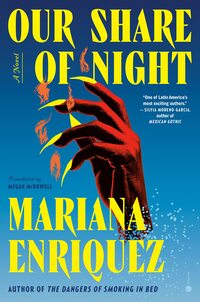
Our Share of Night by Mariana Enríquez 

First published in Spain in 2019; published in translation by Random House/Hogarth on February 7, 2023

Our Share of Night is a literary horror novel, a domestic drama with a supernatural twist. A father hopes that his son did not inherit his connection to the Darkness. When it becomes apparent that his son shares his ability to summon the Darkness, he wants to shield his son from his wife’s family, who expect the Darkness to reveal the secret of immortality. The son loves and hates his father. He will eventually need to confront his family, just as his father did.

The Order regards Juan Peterson as a medium, an essential bridge to the Darkness and its secrets. The Order has deep roots in England, but a branch of the family moved to Argentina, where it is ruled by the matriarch Mercedes. Juan and Rosario, the daughter of Mercedes, had a son named Gaspar. Rosario died three months before the novel begins, but Juan should still be able to speak with her. He cannot find her because she has been hidden from him. Who did the hiding?

Juan was born with a defective heart. He’s had multiple surgeries, but he knows his condition will lead to a premature death. Before he dies, Juan is desperate to find a way to keep the Order from taking control of Gaspar. The Order wants to compel Juan to allow his essence to enter Gaspar at the moment of death. The transmigration of consciousness is the secret of immortality that the Order craves. Juan wants his son to live his own life, not as a continuation of Juan and not a life of servitude to the Order.

Juan is convinced that Rosario was murdered because she wanted to protect Gaspar from the clutches of her family. When the story opens, Gaspar is only six. The Order does not know whether Gaspar has inherited the ability to become a medium. Juan learns the distressing truth when Gaspar begins to see dead people. Juan keeps that knowledge a secret from family members as he teaches Gaspar to make the dead go away.

The story spans generations as it traces the history of the Order. Mercedes is the “priestess of a god who ignores her.” She is always looking for new mediums but Juan is the best she has found. Mariana Enríquez details the rituals the Order follows to satisfy the hunger of the Darkness. Initiates willingly, even ecstatically, lose limbs when they touch the Darkness after it is summoned by a medium. It’s rare for horror novels to make the supernatural seem real rather than silly, but Enríquez has created a shadow world that seems just as real and even more frightening than the world we inhabit.

The novel’s first half focuses on Juan and his relationships with other family members who belong to the Order, including Rosario’s half-sister, with whom Juan has a complicated and intimate history. Much about Juan is complicated, from his bisexual relationships with family members to his parenting of Gaspar. Is Juan an abusive father or is he doing what must be done to protect his son?

Gaspar comes into his own when he enters an abandoned house with his friends. One of those friends is Adela, a distant relative who lost her arm to the Darkness. The door to the house is locked but Gaspar has the ability to enter locked doors. They discover that the house is larger on the inside than its outside dimensions. Adela enters a room in the house and closes the door behind her, challenging Gaspar with the only door he cannot open. Adela is never seen again (at least not in the corporeal world). Her disappearance will trouble Gaspar in the years to come. Gaspar will also be troubled by memories, or the absence of memories that would explain gaps in his life. Those memories will eventually return and illuminate Gaspar’s history with his father, but only after his father’s death.

Like many good horror novels, the story contrasts supernatural terror with the horror that is part of life in the seen world. Chapters in the second half follow several characters, often embodying a different aspect of life in Argentina at different times in the nation’s turbulent history. Pablo is one of Gaspar’s friends who entered the house with Adela. Pablo is secretly in love with Gaspar, but Gaspar is straight. As he grows older, Pablo struggles to balance his fear of AIDS — a disease that eventually claims most of his friends — with the thrill of anonymous sex. Pablo is shunned by moralistic Argentina. He still feels the hand that grasped his shoulder when he was lost in the house where Adela disappeared. Perhaps the supernatural forces that haunt him are symbolic of the other fears that torment gay men in Argentina.

Vicky was also in the house with Gaspar and Pablo. Ten years later, she’s a talented medical student, with an almost supernatural ability to diagnose hidden diseases. She wants Gaspar to believe that his occasional encounters with (the ghost of?) Adela are hallucinations brought on by epilepsy. The reader, like Gaspar, will doubt that medicine can explain the experiences that Gaspar, Pablo, and Vicky have. The novel asks whether disease and mental illness might be an outsider's explanation of perceptions they do not share or understand.

A late chapter follows a journalist who tries to investigate the story of Adela. She learns how difficult it is to find Gaspar, even when she knows exactly where he lives. Another chapter follows Gaspar as he is haunted by the ghosts of his father and Adela. Psychiatric care does no good in a country where disappearances are common and everyone feels haunted. Argentina’s military dictatorship is a version of the Darkness; its believers control the nation in the way that the Order controls Gaspar’s family.

The novel covers an impressive amount of ground without ever causing confusion. Enríquez’s crystalline prose build a supernatural world that no less sharply focused than the Argentina in which her carefully crafted characters live. Themes of family drama (a well-meaning father whose parenting is cruel because he knows no other way; a mother who shields her child from the child's controlling grandmother) will resonate with families that are troubled by violence and strife that has no supernatural origin. A strong ending resolves Gaspar’s immediate problem while recognizing that the pain of lost souls and the risk of new horrors are always a part of life. Our Share of Night sets a new bar for literary horror novels.

RECOMMENDED

Wednesday
Jan252023

After Many a Summer by Tim Powers

Published in spring 2023 by Subterranean Press

Subterranean publishes nice print editions of old and new works by established writers in the fields of science fiction, fantasy, and horror. This novella will be available in a trade edition, but the more expensive limited and lettered editions include full-color endsheets. Here’s a glimpse:

As this novella begins, an unsuccessful screenwriter named Conrad is pretending to be a homeless drunk who has staked out a spot near a 7-11 parking lot. Conrad, who has some real life experience with homelessness and alcoholism, has accepted a studio’s offer to purchase and produce his screenplay if, in exchange, he takes a car from the 7-11 parking lot and transports a package in the trunk to a stated location. He’s supposed to change cars a couple of times along the way.

Conrad assumes that the package he’s delivering is some sort of ransom. Horror fans know that the cardinal rule in situations like this is don’t open the package. Horror fans also know that the story won’t get started until the protagonist opens the package.

Curiosity gets the best of Conrad before he arrives at his final destination. He discovers that the package contains a shrunken head attached to a stick. He presses a button on the stick and the head asks, “Pray thee sir, whose dog are you?” Other than asking Conrad to kill him, the head’s conversation doesn’t always make much sense.

The head is some sort of oracle. It calls itself Tithonus. In Greek mythology, Tithonus begged the gods for immortality and was granted his wish, but never stopped aging, making immortality a miserable state of existence. Tithonus is also the title of a Tennyson poem from which the title of the novella is drawn. Readers of Greek mythology, Tennyson, and horror fiction all know that immortality is a curse. That’s particularly true when you’re living your life as a shrunken head on the end of a stick.

The hostage victim explains the oracle’s powers and how her family acquired it, but as readers of such stories know, nothing good ever comes from learning the future from a shrunken head. Conrad’s adventure takes him through a series of repeating, time-distorted events. He saves the woman who is being held hostage, unless she dies. He shoots a man, unless he doesn’t. Life is confusing when you’re unstuck in time.

Tim Powers has a long history of writing entertaining stories that often feature supernatural themes. The novella shares some of the flavor and time travel themes of his most celebrated novel, The Anubis Gates. Still, this is a less substantial work. After Many a Summer lacks the detail, careful characterizations, and surprises of Powers’ longer fiction. Having said that, the story is fast and fun, a good way to kill an evening for readers who want to read something spooky and unchallenging.

RECOMMENDED

Wednesday
Dec282022

A History of Fear by Luke Dumas

Published by Atria Books on December 6, 2022

Grayson Hale has a history of fear. Perhaps he is afflicted with satanophobia, a condition describing an abnormal fear of the devil, but Grayson might have legitimate reasons to fear the Adversary. Whether the devil is real or in Grayson’s head — and whether the distinction makes a difference — is the question that propels the novel.

We learn in the opening pagesl that Grayson died after he was convicted of murder. He left behind a manuscript, the story of his life. An editor has annotated the manuscript with documents and interviews that shed light on what might or might be true in Grayson’s memoir.

As a child, Grayson’s fear was triggered by Dirt Devil commercials, deviled eggs, or a chance encounter with the number 666. The fear escalated after Grayson began to be plagued by winged creatures with needle-like teeth. Grayson eventually decided that the fiends weren’t real, a conclusion that followed from the inability of anyone else to see them. Grayson believed that one of the fiends scratched its mark into his arm when he was a baby — he still has the scars — but that was Grayson’s only physical encounter with demonic beasts before they vanished from his life.

Grayson’s father was a divinity scholar who doubled as a cult leader, although Grayson did not recognize the fellowship as a cult. Grayson’s father warned him to be wary of the Adversary. His mother threatened to show him the wrath of the Lord if he misbehaved. His brother, with his mother’s tacit approval, tried to beat the sin out of him. His father gifted Grayson with a book about a boy who had an insatiable hunger that was implanted by the devil. The book occasionally returns to haunt Grayson, providing a metaphor for his life that he doesn’t understand.

Grayson angered his father by following him in a park when he should have kept his distance, but he apparently repressed the full memory of what he saw. Grayson’s father either died in an accidental fall or jumped to his death, leaving behind a cryptic note that might provide insight into the true demons that torment Grayson.

The story begins when Grayson travels to Scotland to pursue his studies. Grayson needs to maintain enrollment and find some income to remain in the country. His need for cash seems to be met by D.B., who hires him to write a book about the history of the devil in Scotland. D.B. wants Scotland to remember the devil. The true nature of the book D.B. wants Grayson to write is not revealed until the final pages.

The winged creatures come back into Grayson’s life when D.B. enters it. Grayson comes to believe that D.B. is Satan. The reader might wonder whether Grayson, who blacks out from time to time, blames demons for his own actions. But if the fiends aren’t real, is D.B.? Grayson devotes the last part of his “book” to his search for the truth. He finds answers that tie together many of the novel’s loose ends while contributing to the story’s ambiguity.

Perhaps the supernatural exists, but the narrative offers clues to an alternative explanation of Grayson’s history of fear: his abandonment by a friend in childhood who didn’t like the way Grayson played; his lack of sexual attraction to his girlfriend; his obsessive desire (noticed by others but not by Grayson) to be close to Liam Stewart, a popular schoolmate who denied having a friendship with Grayson. Luke Dumas apparently did not trust readers to piece the clues together. He eventually (and unnecessarily) spells out the truth, a decision that dumbs down the novel. Yet the question of the devil’s reality always lurks.

Dumas emphasizes Grayson’s unreliable narrative and the mechanisms of self-protection that shield him from the truth. Whether Grayson’s perceptions are accurate or delusional, Grayson’s voice is clear even when his thoughts are not. Dumas’ characterization of Grayson as a troubled young man who lacks self-awareness is convincing.

Familiar themes include a son who is desperate for a father’s approval, a mother who is more concerned with appearances than reality, the way abusive behavior is passed from generation to generation, the bigoted condemnation of “deviant” sexual behavior, and the lasting harm that religious intolerance inflicts on children. The novel’s premise — maybe the supernatural is real, maybe it is imagined by ill minds, maybe the supernatural preys on ill minds — is also familiar, but Dumas executes the balance between competing explanations for Grayson’s experiences — supernatural forces and mental illness — with skill.

I’m not a big fan of the supernatural in fiction, but I appreciate stories that build upon the ambiguity that is inherent in unanswerable questions. The final section, reflecting the views of the editor who annotates Grayson’s memoir, purports to clarify the ambiguity but adds to it by making the reader wonder about the editor’s true identity. While A History of Fear might have a greater impact on true believers in Satan, it tells an intriguing story for readers who appreciate how little we understand about the nature of reality and the complexity of the human mind.

RECOMMENDED

Friday
Oct282022

Jackal by Erin E. Adams

Published by Bantam on October 4, 2022

Alice Walker was ten before she realized that her skin color differed from her peers. Alice was killed in 1986, soon after she made that discovery. Her death in the woods was deemed accidental. Alice’s heart had been removed from her chest, an inconvenient fact that authorities attributed to “animal activity.” Keisha Woodson suffered a similar death in the same woods in 2002. Morgan Daniels disappeared in 1994. They aren’t the only black girls who lost their hearts in the woods, but the police in Johnstown fail to notice a pattern.

Liz Rocher’s mother is Haitian. Liz was born in 1985, the year the first black girl disappeared in the woods. Liz had a bad experience of her own in the woods on the day Keisha disappeared. Liz remembers an encounter with a monster in a shadow (or maybe it was a dog), but her mind might have constructed a false memory to protect her from the truth. Melissa Parker helped Liz find her way out of the woods that day.

Liz returns to Johnstown in 2017. She has bad memories of the school where she was labeled an oreo, too white in her manner of speech for the black kids, too black in appearance for the white kids. Her teachers believed black people were “an alien anomaly in white suburban perfection.” Her only friend was Melissa, a white girl who didn’t have the looks or money to fit in with the other white girls. Liz left Johnstown because too many people in town could only look at her “in a way that makes themselves feel superior.”

Liz only returns because Melissa is finally getting married to her boyfriend, Garrett Washington. They have a daughter named Caroline. Melissa’s father was skeptical of his daughter’s decision to have a baby with a black man, but he finally decided to meet his granddaughter after he bonded with Garrett while hunting for deer.

The wedding reception is at the edge of the woods. Liz is supposed to be keeping an eye on Caroline, but Caroline disappears while Liz is getting drinks. Liz looks in the woods when she can’t find Caroline and finds a bloody piece of Caroline’s party dress.

With that setup, the story addresses “missing child” themes that are common to crime novels. The story adds a reasonably creative mix of horror themes (don’t peer into shadows; Liz has bright eyes that signal someone who has been touched by the woods). Racial and historical themes add powerful context to the plot. In 1923, the mayor of Johnstown ordered more than 2,000 African Americans and Mexican immigrants to leave the city. Liz wonders how she could have grown up in the city without learning that fact. It’s the side of American history that white supremacists don’t want schools to teach, but it belongs with the St. Louis race riots and the Tulsa race massacre as a moment in American history that every child should study. Jackal is in part a horror novel, but what happened in those cities is the true horror.

The story offers several suspects who may be involved in the disappearance of Caroline and/or all the other missing black girls, assuming they are missing and the disappearing girls aren’t just an urban lesson. Suspects include Melissa’s father and husband, Keisha’s mother, a cop named Doug who helps Liz develop a map of missing girls, and a guy named Chris who encountered Liz in the woods on the night that Keisha disappeared. Not to mention a shadowy dog monster that might be lurking in the woods. Maybe the killer is supernatural. Maybe the killer belongs to a satanic cult performing one of those annual solstice sacrifices that thriller writers love to imagine.

I won’t spoil the ending, but it’s fair to say that the resolution combines a murder mystery with the supernatural. The explanation for the unsolved (perhaps unnoticed) killings is a stretch. So is the motivation that drives the supernatural entity.

Stories of the supernatural merit the suspension of disbelief only if they are frightening; Jackal fails to meet that test. Liz’s important learning moment at the novel’s end is a bit contrived, although I liked the use of a supernatural entity as an allegory for the racial hatred that divides the nation. I’m recommending the novel for the mild suspense it generates, for Erin E. Adams’ effort to build Liz into a fully realized character, and for the important themes that hold the story together.

RECOMMENDED