The Tzer Island book blog features book reviews written by TChris, the blog's founder.  I hope the blog will help readers discover good books and avoid bad books.  I am a reader, not a book publicist.  This blog does not exist to promote particular books, authors, or publishers.  I therefore do not participate in "virtual book tours" or conduct author interviews.  You will find no contests or giveaways here.

The blog's nonexclusive focus is on literary/mainstream fiction, thriller/crime/spy novels, and science fiction.  While the reviews cover books old and new, in and out of print, the blog does try to direct attention to books that have been recently published.  Reviews of new (or newly reprinted) books generally appear every Monday, Wednesday, and Friday.  Reviews of older books appear on occasional weekends.  Readers are invited and encouraged to comment.  See About Tzer Island for more information about this blog, its categorization of reviews, and its rating system.

Entries in Japan (37)

Wednesday
Jun122013

Evil and the Mask by Fuminori Nakamura

First published in Japan in 2010; published in translation by Soho Crime on June 11, 2013

"It wasn't revenge. I simply wanted to set him on fire. Air, that was the word that came to mind. I felt as little emotion as air." Fumihiro wants to destroy evil, but does the killer of evil become the thing he kills? That question lies at the heart of Evil and the Mask, the second novel by Fuminori Nakamura (after The Thief) to be translated into English.

Evil and the Mask opens with a fascinating premise. It is a tradition for men in a certain family, after attaining the age of sixty, to sire a child who will become a cancer in the world, tasked with spreading misery. The men do this to punish the world for continuing to exist after they perish. In an attention-grabbing first chapter, Shozo Kuki explains the tradition to his youngest son, Fumihiro. Shozo tells Fumihiro he will experience hell when he turns fourteen. Hell will somehow involve Kaori, an orphaned girl Shozo adopted, and to whom Fumihiro becomes attached.

The novel jumps between the formative events of Fumihiro's childhood and the present, more than a dozen years later. The adult Fumihiro has changed his face to match that of Koichi Shintani, a dead man whose identity Fumihiro purchased on the black market. The plot springs forward along three twisted paths. One involves Shintani's past and the baggage that comes with it. Another brings Fumihiro (with Shintani's face) into Kaori's life again, but in a very different role. The third introduces a cultish group of pseudo-terrorists who use absurdity to undermine culture.

Like The Thief, Evil and the Mask is a novel of psychological suspense. The story's strength involves Fumihiro's struggle to shed one identity and to adopt another, to reinvent himself -- an impossible task, perhaps. It's easy to change a face and a name, not so easy to change your inner self, to abandon memories. Unlike The Thief, however, Evil and the Mask is so determinedly a novel of psychology that some characters indulge in lengthy analytical speeches -- about beauty, death, morality, anarchy, entropy, familial love, the motivations for violence and war, the nature of evil -- that too often seem forced.

Still, the character of Fumihiro is impressively constructed. The reader feels the crushing weight of his oppressive past, his struggle to feel something. His coffee has no flavor, he doesn't notice the cold. He is little more than an animated corpse. He has forsaken the happiness he experienced while he and Kaori were still innocent -- a happiness that the adult Fumihiro regards as "some kind of mistake" that "soon vanished into the distance." He still longs for Kaori but fears that another character's prediction will come true, that he will destroy the one thing in the world that remains precious to him if he gets close to her. Can Fumihiro shed the despondency that consumes him only by embracing madness? Whether his future is to be determined by destiny or choice, the novel's dramatic tension comes from the uncertainty of the path that Fumihiro's life will follow.

Evil and the Mask is a meditation on change and choice, on killing and on what it means to be alive. Apart from its philosophical implications, the story is intriguing. The plot threads weave together convincingly, although the storyline involving Shintani's past doesn't quite reach its potential. The ending (like The Thief, inconclusive, permitting the reader to imagine what might happen next) is satisfying.

RECOMMENDED

Sunday
Mar312013

Paprika by Yasutaka Tsutsui

First published in Japanese in 1993; published in translation by Vintage Contemporaries on February 12, 2013 

It's hard to know what to make of Paprika. There's a surrealistic bizarreness to the story that is both appealing and frustrating. The surrealism is a natural component of the story's subject matter: the intersection of dreams and conscious thought.

Paprika imagines a world in which mental illnesses can be detected with devices that scan "the inside of the psyche." One such device is a dream collector that allows a therapist to monitor (and actually enter) a patient's dreams. Now that the devices have been legalized, two researchers are at the cutting edge of the technology: Atsuko and Tokita. One storyline involves a Beauty and the Beast love story between Tokita, who is obese and socially stunted, and Atsuko, whose love for Tokita is rivaled by her love for one of her patients.

The best dream detective is a woman with dual identities who is known in her younger persona as Paprika. Paprika has not worked in several years -- when she was working, the devices were still illegal -- but she's asked to rejoin the Institute for Psychiatric Research to diagnose the neurosis of a businessman named Tatsuo Noda, who is suffering from panic attacks. Paprika's work with Noda, and the secret of Paprika's true identity, gives rise to the novel's second storyline. This evolves into the story of Noda's work, the difficult decisions he must make and the rivalries with which he must cope. The corporate intrigue provides some of the novel's best moments.

The dream collector has certain drawbacks. Therapists can become lost in a patient's mind. A therapist named Tsumura has apparently become infected with a patient's schizophrenia by using the dream collector, but Atsuko suspects that the device was sabotaged. This provides the novel's third plot thread, evolving into a tale of conspiracy as factions within the Institute wage war against each other. That storyline gives the novel its binding narrative but it is also the novel's least interesting aspect.

There are other plot threads and many other characters woven together in this complex and occasionally confusing book. One of the characters is an embittered, misogynistic co-worker who is envious that Atsuko might win the Nobel Prize he was denied. Other characters are patients who, like the therapists, suffer from a variety of anxieties and mood disorders. Nearly all of the characters are developed with surprising subtlety given the novel's brevity.

Jungian dream interpretation and the insight it offers into anxiety and depression is the novel's most interesting theme, and the dream sequences are the best (if also the most ambiguous) in the book. Time and place shift unpredictably and words become garbled; sometimes text is represented as **** because the narrator can't understand what is being said. Yet the novel goes beyond dream analysis. It is also about the confusion (and potential merger) of dreams and reality. Dreams and reality become hopelessly tangled, leaving characters in an understandable state of confusion. If dreams can create reality, should you react to the new reality by pretending you're in a dream? And how do you know whether you're dreaming?

The novel incorporates a number of sex scenes. They are not limited to traditional two-person, male-female coupling. The scenes aren't particularly graphic, and those that are dreamt don't always make sense, but some readers might find them disturbing. Both while she's dreaming and while she's awake, Paprika is raped or nearly raped. Her fatalistic acceptance of sexual assault might upset some readers, as might a dream in which she's begging a man to rape her (or just to have sex with her, whichever he prefers).

Because Paprika is a difficult novel to absorb, I found myself reading a few of the short chapters, then chewing on them for a day or two before returning to the novel. Perhaps I should have soldiered through it in fewer sittings, and if I were to read it again (a second reading would, I think, help me grasp its subtleties), that's probably what I would do. While I ultimately admired the novel and even enjoyed most of it, I'm not sure whether I'll ever be up to a reread because the first reading was a bit draining. Maybe in a few years, after it settles in, I'll tackle it again.

RECOMMENDED

Monday
Feb042013

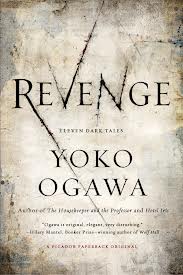
Revenge by Yoko Ogawa

Published in Japanese in 1998; published in translation by Picador on January 29, 2013 

The short stories collected in Revenge tend to be snapshots of turmoil, slices of emotion-charged lives. A woman spends an "Afternoon at the Bakery" where she goes to buy strawberry shortcake for her son's birthday, twelve years after he died while trapped inside an abandoned refrigerator. A paranoid woman gathers the tomatoes featured in "Tomatoes and the Full Moon" from an overturned truck at the scene of a fatal accident, then befriends a travel writer who discovers that she has a surprising secret. In "The Last Hour of the Bengal Tiger," a woman who is jealous because her husband is having an affair invents games of chance that dictate her behavior. A hospital secretary who has a crush on her boss listens to her boss' shocking confession in "Lab Coats." A bagmaker in "Sewing For the Heart" is asked to make a bag that will hold a woman's heart. A woman examines instruments of torture in "Welcome to the Museum of Torture" and imagines what she might do to her boyfriend. The curator of that museum dies and, while attending his funeral, his niece recalls him as "The Man Who Sold Braces" that might as well have been torture devices.

The stories are related to each other in ways that aren't immediately apparent. A girl asks a boy she doesn't really know to join her at an uncomfortable lunch with her estranged father in "Fruit Juice." During the course of that story, the boy and girl come across an old, abandoned post office that is filled with kiwis. The kiwis are from the orchards of "Old Mrs. J," who also grows carrots shaped like human hands. That story is narrated by a tenant in one of the old woman's apartments. The tenant had been the stepmother of a boy who, in "The Little Dustman," recalls her eccentricities as he travels to her funeral. The aging woman in "Poison Plants" is fascinated by the sound of a young man's voice as he reads her a story about a post office filled with kiwis. And so on.

Yoko Ogawa writes in a minimalist style that is exquisite in its simplicity. Some of the stories seem odd but uneventful until they arrive at twisted, almost ghoulish endings. A sense of the macabre links the stories as much as the characters they share. These aren't horror stories in the traditional sense, but many of the characters are isolated or damaged, living a daily horror that outsiders can't imagine.

The stories come full circle, the last connecting to the first. Often a story's connection to another story becomes clear only at the end, a revelation that shifts the story's context just a bit. The reader gains new insight into Ogawa's characters after realizing that the character played a role in an earlier story. The interlocking nature of the stories builds a depth that is greater than the stories achieve individually. It's tempting for that reason to devour the stories all at once, although it's also rewarding to pause and savor each one, like nibbling from a box of gourmet chocolates.

RECOMMENDED

Monday
Mar072011

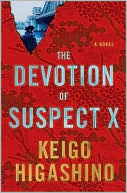
The Devotion of Suspect X by Keigo Higashino

Published by Minotaur on February 1, 2011

The Devotion of Suspect X is a different kind of crime novel. It isn't a whodunit: we learn in the opening pages that Yasuko kills her ex-husband, Togashi. Nor is the manner or motive of the killing a mystery: Togashi's aggressive behavior toward Yasuko and her daughter, and Yasuko's strangulation of Togashi with her daughter's assistance, are vividly described. For much of the novel, The Devotion of Suspect X seems like a police procedural combined with a detective story. The role of private detective is played by a physicist, Yukawa, who happens to be a good friend of the investigating police officer, Kusanagi. Yukawa also happens to be an old classmate of Yasuko's neighbor, a mathematician named Ishigami, who assisted Yasuko in the aftermath of the killing. Initially, the mystery surrounds the body that turns up days later -- with a pulped face and charred fingertips -- and whether Ishigami's scheme to keep the police from proving Yasuko's complicity will be successful. Yet about two-thirds of the way through the novel, the plot takes a sharp turn, and a new mystery emerges: Why is Suspect X doing something so completely unexpected?

I enjoyed The Devotion of Suspect X. Keigo Higashino's writing style (or perhaps the translator's) is straightforward; the prose doesn't soar but neither does it distract. The novel is tightly constructed; there's nothing in it that doesn't need to be there. Yasuko is a remarkably bland character (given that she's a killer) but the Buddha-like Ishigami and his friend Yukawa are interesting and their battle of wits brings the story to life. Ishigami's interaction with Kusanagi (another bland character) is less interesting but it serves to advance the plot.

The Devotion of Suspect X isn't a spectacular work of literature but it tells a good story. The plot unfolds rapidly and surprisingly. There is, ultimately, a mystery to unravel, and its solution completely floored me -- yet the author played fair: all the clues were there. The last couple of pages are a bit disappointing in that one of the characters behaves too predictably (probably the result of the author's desire to keep readers happy), but that gripe didn't overcome my generally positive feelings about the book.

RECOMMENDED

Wednesday
Feb022011

The Hunter by Asa Nonami

 First published in Japan in 1996.  This review is of the English translation by Juliet Winters Carpenter published by Kodansha International in 2006.

 Takako Otomichi is a female cop in a man's Japan. When a murder victim dies in a fire started by an incendiary device hidden in his belt, Takako is among the detectives assigned to the case. She's partnered with a male detective sergeant who views her as an ornament. The investigation seems to be running out of steam when a second gruesome death occurs, this one apparently caused by a wild dog or a domesticated wolf. The relationship between the killings is the mystery that occupies Takako professionally. Divorced and living alone until her annoying sister shows up, Takako's personal life frustrates her as much as her job.

Takako's perseverance makes her a sympathetic character, but she is also easy to like: she's smart, she's tenacious, and she has a biting sense of humor (although, for the most part, she keeps her sarcasm to herself). She thinks of her partner as "the emperor penguin." Her partner fits the stereotype of the career cop who has sacrificed his family to his job, who drinks too much and doesn't trust women. Although most of the story is presented from Takako's point of view, we sometimes see the novel's events through her male partner's eyes. The differing perspectives offer insight into the failure of the partners to communicate -- the two characters make assumptions about each other that, left unspoken, make it impossible for them to work as a team.

The subordinate role of women in Japanese society is a recurring theme in Japanese crime fiction (it appears in Out and The Cage among other novels); in The Hunter, Takako does her best to ignore the persistent sexism she encounters, even when it hobbles her investigation. She also tries to ignore her domineering mother and hapless sister, but doing so only adds to her stress. She feels best about herself when she's riding her motorcycle. Her connection to the mysterious animal she ends up tracking (as well as her love of riding) suggests her desire for freedom, a desire that is only a dream given the relentless demands of her job and family.

Readers looking for a strong female character should enjoy The Hunter. The novel isn't a whodunit -- there isn't much in the way of clues for the reader to piece together -- but the story moves quickly and in unexpected directions. The connection between the crimes is a bit farfetched, but that's common enough in thrillers. It's interesting to compare issues of gender equality across cultural lines, but it's even more interesting to read about Takako battling the kind of personal demons that afflict people in every culture. The prose in The Hunter flows more naturally than it does in some other novels translated from Japanese that I've read. For its intriguing central character and enjoyable story, I recommend The Hunter to fans of thrillers, police procedurals, and Japanese fiction.

RECOMMENDED