The Tzer Island book blog features book reviews written by TChris, the blog's founder.  I hope the blog will help readers discover good books and avoid bad books.  I am a reader, not a book publicist.  This blog does not exist to promote particular books, authors, or publishers.  I therefore do not participate in "virtual book tours" or conduct author interviews.  You will find no contests or giveaways here.

The blog's nonexclusive focus is on literary/mainstream fiction, thriller/crime/spy novels, and science fiction.  While the reviews cover books old and new, in and out of print, the blog does try to direct attention to books that have been recently published.  Reviews of new (or newly reprinted) books generally appear every Monday, Wednesday, and Friday.  Reviews of older books appear on occasional weekends.  Readers are invited and encouraged to comment.  See About Tzer Island for more information about this blog, its categorization of reviews, and its rating system.

Entries in Paul Yoon (3)

Monday
Jul272026

Etna by Paul Yoon

Published by Scribner on August 4, 2026

The phrase “dogs of war” originates in Shakespeare’s Julius Caeser and is the title of an excellent Fredrick Forsythe thriller, but dogs are not characters in either the play or the novel. Etna is a true “dogs of war” story. It tells the story of war and its aftermath from a dog’s perspective.

The war is waged for four years in an unidentified country, presumably South Korea. American and European soldiers are among the combatants who have arrived to defend the country from an unidentified enemy. Given the use of drones and cellphones, this is a modern war, not a story from the past.

A doctor named Soojin belongs to the army of the country where the novel takes place. She has the ability to communicate with dogs. The Americans have hired her to identify and train dogs who can help with the war. On a farm, she finds a twelve-month old mixed-breed shepherd. She names him Etna, after a volcano, although a bird later tells Etna that in Greek his name means “to burn.”

The story is told from Etna’s point of view. Etna explains that animals communicate with each other silently (“it was like dark shapes appeared and lived in a space between our eyes, shapes we could translate”), but Etna feels Soojin’s words “more physically, and around me: it was like the air was pressing against my ears, and then a small door opened in my head into a corner I had never been inside before.” I’ve had dogs who seemed to understand everything I say (and some who have understood nothing, unless they were feigning ignorance), but I envy Soojin’s ability to understand their language.

Soojin named a second dog Fuji. She urges Etna and Fuji to find her when the war is over so they can move to Italy and live in peace.

The army trains the dogs to attack the enemy, going for the throat when necessary. They are also tasked with sniffing out IEDs and buried mines.

The war lasts four years. The soldier who handles Etna takes good care of him but doesn’t want to keep him when the war ends. “I wasn’t his dog. When he saw me, he saw the dog he had worked with and fought alongside and lost.” Before the war is over, however, the soldier proves his love of Etna.

Etna relates some of his wartime adventures, but most of the story takes place after the war ends. Etna has experienced the same trauma that human soldiers endure. “I had seen mountains burn. I had seen lakes burn and boulders burn and airplanes burn and tanks burn and animals burn and humans burn and bones burn. And when there was nothing left to burn, there was still the sound of it. I would always remember the sound of the burning.” Humans develop PTSD and I suppose there is no reason to think that dogs react to trauma any differently.

For much of his time after the war, Etna is on his own, trying to get back to the farm where he was born. The war has turned the country into a wasteland and left humans in desperate circumstances. Some humans are still fighting. Some want to eat him. He travels to a city and into the mountains during his quest to return to the coastal farm of his puppyhood.

Etna meets a couple of friendly dogs along the way. A dog named Semeru who shares his dreams of a well becomes his companion. Sometimes they play tug with an old rope because, well, they’re dogs. Pausing to play in the midst of turmoil is one of the many things I love about this novel.

For good reason, Etna is wary of humans, but he encounters another doctor, a kindly man who treats his wounds and helps him with part of his journey. Will Etna reunite with Soojin? That question provides the story with some of its drama.

The importance to dogs of being part of a pack is the novel’s underlying theme. It serves as a reminder of the importance to humans of community and relationships, or at least a sense of belonging. At the same time, Etna and Semeru make clear that being part of a pack doesn’t require us to attack everyone outside the pack or to regard others as outsiders. Etna defends himself and protects his humans as necessary but never condemns other humans or animals (even donkeys) simply because they are different.

Near the story’s end, a bird reminds Etna of the importance of having friends, even if the friends are not like us. If we lose our pack, the bird counsels, we need to find another. It is important not to be alone.

Maybe Etna learns that you can’t go home again. If Etna’s home still exists, it won’t exist as he remembers it. The smells will be unfamiliar. Change is difficult for humans and dogs alike, but the time may come to make a new home, to form or join a new pack. We endure because there is always hope that life will get better. Sometimes it does.

If you can’t abide sadness, don’t read Etna. Paul Yoon doesn’t shy away from tragic moments. He nevertheless balances them with moments of grace. The story is written with deceptive simplicity that almost masks its elegance. Lovers of dogs and literature should find Etna to be a memorable experience.

HIGHLY RECOMMENDED
Wednesday
Jan292020

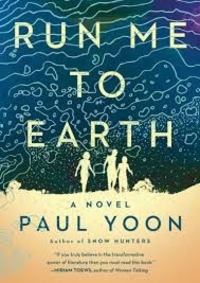
Run Me to Earth by Paul Yoon

Published by Simon & Schuster on January 28, 2020

Many fine novels have been set during the Vietnam War, telling a brutal story from the perspective of American soldiers. Less common are stories told from Asian perspectives. The war took far more lives of Vietnamese than Americans. It spilled into neighboring countries, disrupted families, and destabilized societies. The central characters in Run Me to Earth are Laotians whose lives were changed — or ended — by the war.

Laos was littered with American cluster bombs during the war in an effort to close supply lines used by the North Vietnamese. Unexploded bombs the size of baseballs continue to kill Laotians fifty years later. The war sparked a conflict in Laos between the Pathet Lao and the Royal Lao Government. The CIA supported the RLG in a futile effort to thwart the spread of communism. Part of that support consisted of training Hmong fighters to resist the Pathet Lao.

The initial focus of Run Me to Earth is on a Laotian hospital that helps wounded Hmong fighters and civilians. In exchange for American dollars, Prany and Alisak work in the hospital. They were recruited to the job at the age of sixteen. Prany’s sister Noi is a year younger than Prany.

The three live together in a nearby farmhouse that was once owned by a Frenchman who is known to locals as the Tobacco Captain. When Noi was twelve, the Tobacco Captain hired her to help in the kitchen at a party. Noi will not talk about that day, but a later chapter gives us a glimpse of Noi’s experience.

In 1969, when Prany and Alisak are seventeen, American planes arrive to evacuate the hospital workers. A doctor named Vang expects Prany, Alisak, and Noi to join him on the plane. Much of the novel recounts their harrowing journey toward evacuation, a journey that only one of those four characters will complete. That character makes it to France, where he stays in the home of the Tobacco Captain’s brother.

Five years later, the story follows a woman named Auntie who, for a price, smuggles Laotians into refugee camps in Thailand. She yearns for the optimistic time, before the appearance of American aid, when villagers did not realize they lived in poverty. She hears about two familiar characters who have been captured by the Pathet Lao and brutally interrogated. Three years later, the story follows those two characters after their release. They are assigned to work on a village farm, but they have other ideas about where and how they want to live. The meaning of freedom in the midst of war and poverty is one of the novel’s important themes.

Toward the end of the novel we learn about a sacrifice that a character makes so that a girl named Khit can leave Laos. She eventually makes her way to America with a couple who pretend to be her parents. Her new family assimilates as immigrants will do when given the chance, eventually opening a restaurant in Poughkeepsie, yet Khit lives in constant fear that her new life will be taken from her. Fifteen years later she travels to France so that she can keep a promise she made on the day she was smuggled out of Laos. There she learns partial answers to questions the reader will have about the fate of other characters.

Tension becomes palpable as the primary characters struggle to escape the lives that shackle them. They often do so in unexpected ways. Although a work of fiction, Run Me to Earth is infused with details that remind the reader of the tragedy that resulted from America’s intervention in Vietnam and neighboring countries. At the same time, the story invites the reader to make connections to other tragedies — of war, of oppression, of prejudice — all stemming from weaknesses in the human spirit that are partially offset by those who find the strength to resist.

The novel tells a powerful and moving story about characters who make difficult choices under unimaginable circumstances. One choice involves violent retribution, an understandable act even if it is morally questionable. On other occasions, the characters make selfless choices that place the welfare of their friends above their own. Notwithstanding the larger issues that permeate the story, Paul Yoon’s focus on ordinary people in an extraordinary situation gives the novel its heart. Friends are lost and new friends are made. Lives change but survivors endure because others sacrifice. It is impossible not to be wrenched by their pain and inspired by their fundamental decency.

HIGHLY RECOMMENDED

Wednesday
Sep252013

Snow Hunters by Paul Yoon

Published by Simon & Schuster on August 6, 2013

In 1954, at the age of 25, Yohan leaves a prison camp in a UN truck and boards a Japanese cargo ship crewed by South Koreans. Captured by Americans after he was buried in snow during a bombing, Yohan is the only prisoner who declines repatriation to North Korea. Instead, he accepts an offer to apprentice for Kiyoshi, a Japanese tailor in Brazil, a country of which he has never heard where people speak a language he does not understand. Snow Hunters follows several years of Yohan's new life, with flashbacks to his interment and to his younger days, both before and after his country was divided.

Paul Yoon's debut novel is characterized by fine prose and honest emotion. It is filled with powerful images of war and poverty and of lives that are both unburdened and unaided by technology. The novel is built upon resonant scenes of Yohan's life: helping a blind prisoner play poker with medics; dancing in the snow with a tipsy nurse on Christmas; sitting with two Brazilian children, apparently orphaned, as they sell trinkets; Kiyoshi's tears when his hands become too unsteady to pin a jacket; Yohan's habitual search for lost or discarded objects. This is a story of small kindnesses in an unkind world, of people helping each other in surroundings of misery, of kindnesses repaid in unexpected ways.

Several themes echo through Snow Hunters: fate; the unitary nature of the world we all share; the changes -- generally for the better, temporarily for the worse -- that people and places undergo; the impact that seemingly insignificant people have on others; the simple pleasures of life; the changing perceptions of time ("how time could completely abandon someone" when love enters a life). Snow Hunters is a short novel, written with an economy of language that more writers should emulate, but the story is bigger than it first appears. The ending is perfect in its ambiguity because, for Yohan, it isn't the ending. He has more life to live, and how it will turn out is, as always, a mystery.

RECOMMENDED