The Tzer Island book blog features book reviews written by TChris, the blog's founder.  I hope the blog will help readers discover good books and avoid bad books.  I am a reader, not a book publicist.  This blog does not exist to promote particular books, authors, or publishers.  I therefore do not participate in "virtual book tours" or conduct author interviews.  You will find no contests or giveaways here.

The blog's nonexclusive focus is on literary/mainstream fiction, thriller/crime/spy novels, and science fiction.  While the reviews cover books old and new, in and out of print, the blog does try to direct attention to books that have been recently published.  Reviews of new (or newly reprinted) books generally appear every Monday, Wednesday, and Friday.  Reviews of older books appear on occasional weekends.  Readers are invited and encouraged to comment.  See About Tzer Island for more information about this blog, its categorization of reviews, and its rating system.

Entries in HR (70)

Friday
Feb112011

The Sportswriter by Richard Ford

First published in 1986

At some point in The Sportswriter, the title character talks about feeling "a hundred things at once, all competing to take the moment and make it their own, reduce undramatic life to a gritty, knowable kernel." That, I think, is what Richard Ford's novel tries to do. The Sportswriter is a snapshot of a man's undramatic life in middle age, an attempt to make it knowable.

There are those who become bored by novels that lack a conventional plot -- a murder mystery to solve, an alien invasion to defeat -- but it isn't fair to complain (as have many Amazon reviewers) that "nothing happens" during the course of The Sportswriter. Plenty of things happen during the short time span the novel covers: Frank Bascombe visits his son's grave, takes a trip to Detroit with his girlfriend, interviews a mentally shaky former athlete, has Easter dinner with his girlfriend's family, gets punched in the mouth, has significant conversations with his ex-wife and an old girlfriend, endures a male friend's unwelcome advance, chats with a teenage girl after a car knocks a shopping cart into the phone booth he occupies, flirts with an office intern ... nothing terribly exciting, no bombs to disarm or terrorists to defeat, just the random events of a life. But as Frank muses about those events, and as he recalls other events that shaped his life in ways large and small, we come to know him, to understand him ... and, with luck, we may understand ourselves or our friends and family a bit better for the effort of examining Frank's life.

It's unusual and oddly comforting to read a novel about a man who is coming to terms with the tragedy in his life (his son's death and his subsequent divorce), who is neither cynical nor self-loathing, who is trying to live decently and who admits his mistakes. What The Sportswriter lacks in dramatic tension it makes up for with insightful examination: of attitudes, emotions, lifestyles, relationships. It is filled with lessons: happiness comes from living in the moment without the distracted wondering about other, better moments that might exist; an attempt to know everything about another person during a one night stand becomes a miserable substitute for self-knowledge; the future is a mystery to be embraced; the "world is a more engaging and less dramatic place than writers ever give it credit for being." Yet for all the lessons Frank has learned, he's living a deliberately isolated life; he professes to like people but most often stands apart from them, perhaps afraid of new attachments in the wake of losing his son and wife. Frank claims that to be a sportswriter "is to live your life mostly with your thoughts, and only the edge of others'." Frank refuses to admit that his superficial relationships are not caused by his chosen profession. As a defense mechanism against pain, he lives his life largely within his own mind (a state he describes as "dreaminess"), yet he desperately wants to feel close to (and even marry) a girlfriend who he knows isn't right for him. Frank clearly has more to learn, and that too, I think, is one of the book's lessons.  Frank continues to try; he's holding his life together and slowly reopening himself to the world around him.

Finally, the novel is beautifully written. Ford has a pitch-perfect ear for dialog and regional speech patterns. I think The Sportswriter is a remarkable achievement. Although it isn't the right novel for readers who crave fast action or a plot-driven story, I admired it immensely.

HIGHLY RECOMMENDED

Sunday
Jan232011

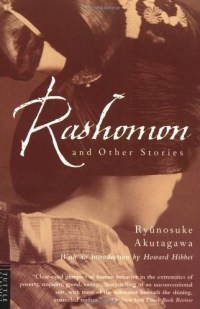
Rashomon and Other Stories by Ryunosuke Akutagawa

Translation by Takashi Kojima.  Introduction by Howard Hibbett.  First published by Tuttle Publishing in 1952.  Akutagawa's stories were written in the first quarter of the Twentieth Century.

The Tuttle Classics edition of Rashomon contains six stories. "In a Grove" recounts a woman's rape and her husband's death from the conflicting perspectives of the rapist, the woman, and the husband, each of whom provides a different account of how the husband died. Akutagawa employs the same device -- telling a story from different perspectives -- in "Kesa and Morito": after a married woman has sex with a man who loathes her, they agree to murder her husband -- but the woman's vision of that crime is quite different from the man's.

"Rashomon" -- a meditation on good and evil, on desperation and hypocrisy -- tells of a servant who cannot decide whether to steal or starve until he meets an old woman who is pulling the hair out of corpses. Lacking compassion or empathy, he fails to recognize himself in her. Similarly, the Christian values of charity and forgiveness give way to hypocrisy in "The Martyr," as Jesuit missionaries and members of the Christian church in Nagasaki condemn a devout parishioner (Lorenzo) on the strength of rumored sin -- only later to declare Lorenzo a martyr after an act of self-sacrifice reveals Lorenzo's true (and surprising) nature.

"Yam Gruel" is the story of an aging samurai who, having been treated with contempt his whole life, clings to a dream -- to eat his fill of yam gruel -- until, finally given the opportunity to fulfill his desire, he questions whether he really wants to do so. In "The Dragon," a priest who is ridiculed because of his long nose decides to pull a prank on his fellow priests by posting a notice board that says "On March third a dragon shall ascend from this pond," only to find the prank taking on a life of its own.

I view these stories as the Japanese equivalent of western fables: teaching life's hard lessons by illustrating the misfortunes that come to those who behave badly. Each story has a moral. The lessons they teach transcend the differences between east and west: the seven deadly sins are just as deadly in Japan as they are in the United States.

Hibbet makes a convincing case that the stories in translation lose the nuances of language that convey the essence of the author's thought. While it is likely true that the stories are richer in Japanese, translation into English does not rob them of their power and vitality. They are a joy to read.

HIGHLY RECOMMENDED

Tuesday
Jan182011

Pennterra by Judith Moffett

Published by Congdon & Weed in October 1987

Isaac Asimov and Brian Aldiss are among the science fiction writers who have incorporated the Gaia theory into their writing. In Pennterra, Judith Moffett exports the concept to an alien world where everything, living and inanimate, is interrelated and in constant communication. The world of Pennterra is in perfect balance until its disruption is threatened by the technology, agriculture, and lifestyles of settlers seeking refuge from the devastated Earth they've fled.

Quakers are the first to colonize Pennterra. Before they can build their civilization, they encounter the hrossa, an intelligent species that communicates by empathy. They make peace with the hrossa, just as the Quakers who colonized Pennsylvania made peace with the Delaware Indians. To co-exist with the hrossa, the Quakers must agree to use no machinery, to limit their population growth, and to live only in a designated valley. But just as later settlers in Pennsylvania were willing to displace the Delaware, the Earth colonists who follow the Quakers are unwilling to abide by hrossa-imposed restrictions. The first part of the novel sets the stage for that conflict. The second part is written in the form of field notes as the Quakers engage in a scientific and anthropological investigation of a hrossa village. Living closely with the empathic hrossa during breeding season proves problematic, as the Quakers feel and share the intense and urgent sexual desires of the hrossa. The novel's third and final part resolves the conflict between the non-Quaker colonists and the hrossa (or more specifically, the spirit of the planet, for lack of a better brief explanation). There's also a bit of wilderness adventure toward the end.

Pennterra is the first novel written by Judith Moffett, whose background as a poet is reflected in her careful use of language. Although she makes Pennterra and the hrossa come alive, she does so without sacrificing development of the novel's human characters. This is, above all, a character driven story, and the main characters each have a unique, fully developed personality. The reader comes to know them well, and to appreciate their struggles.

Although I greatly admired Pennterra, it is not a novel that all readers will enjoy. The story unfolds slowly and is all the more enriching because of its languorous pace, but readers who want fast action in their sf won't find it here. Fans of hard sf might not like this novel; there's a bit of hard (biological) science, but the story depends on people, not science. Finally, there is a fair amount of sexual activity, some involving minors, that violates nearly every imaginable sexual taboo. If this were not a work of science fiction, there would probably be calls to ban and burn it. Science fiction is a literature of ideas, however, so I would expect most sf fans to understand and appreciate Moffett's rather daring concept: what is taboo on Earth may be accepted as normal behavior in an alien environment. Readers who would be put off by frank discussions of that nature should avoid Pennterra.

In an age when so much sf is the same old same old, Pennterra offers something completely different. It is a beautifully written, moving and thought-provoking novel.

HIGHLY RECOMMENDED

Friday
Jan142011

The Ox-Bow Incident by Walter Van Tilburg Clark


First published in 1940

Some readers dislike The Ox-Bow Incident because they expect to find the elements of a traditional western -- morally pure heroes defeating evil outlaws in gunfights -- and are disappointed by their absence. The Ox-Bow Incident does not follow that formula. It is a novel about good (and not so good) men who do an evil thing, men who succumb to a mob mentality, who (in today's language) fear being seen as "soft on crime" and take the law into their collective hands to assure "justice." The novel is in large part a condemnation of vigilantism that, while set in the past, remains relevant to the modern world.

One of the characters in The Ox-Bow Incident complains that "law, as the books have it, is slow and full of holes." The current version of that complaint holds that "criminals have all the rights." People who utter those words forget that those rights protect the innocent from undeserved punishment. The Ox-Bow Incident reminds us that the rights conferred by law do not hinder justice; they are an indispensible component of justice. The men (and one woman) in The Ox-Bow Incident who arrogantly or blindly decide to dispense with the law because "it is slow and full of holes" learn that the law, while imperfect, is more capable of achieving justice than men handing out punishments on their own authority.

Yet The Ox-Bow Incident is more than a condemnation of vigilantism. It's also a psychological study. A reviewer here complained that the plot was too obvious, but this isn't a whodunit or a mystery. The novel isn't so much about what the men do as why they do it. Clark reveals the minds of characters who are afraid to show emotion, who connect with others only in very superficial ways. Most of the characters are constantly worrying about how they look to their peers, always ready to start a fight to defend their honor against the slightest affront to their manhood. They live in dread of their own feelings and are afraid to speak out against injustice if doing so might make them seem weak. 

While some readers find them boring, the novel's philosophical discussions are its strength. Clark didn't settle for a simplistic view of the Wild West that pits good men against evil-doers. The characters are a mixture of good and bad; even when they are basically good, they commit "sins of omission" by failing to stand up for their beliefs. One of the characters likens the posse to a wolf pack, none of its members willing to think independently for fear of being perceived as a lesser man than the rest. Other characters debate the nature of justice. One talks about how much easier it is to have physical courage than moral courage. The narrator (Croft) and another character (Sparks) wonder whether vengeance is God's work or man's.

The Ox-Bow Incident asks compelling and fundamental questions about the individual's role in society. On top of that, it's a well written story. Look elsewhere if you want to read a traditional western, but pick up The Ox-Bow Incident if you want to read an entertaining and thought-provoking novel that has something important to say about human nature.

HIGHLY RECOMMENDED

Tuesday
Dec212010

Home Run by Gerald Seymour

Published by The Harvill Press on May 30, 1989; published in the US in 1991 under the title The Running Target

Writers of espionage novels are inevitably compared to John Le Carré, particularly if the writer is British. Gerald Seymour's writing style isn't as polished, and the characters in Home Run lack the multi-layered depth of Le Carré's best characters, but the plot and pace of Home Run are worthy of the master.

Home Run begins with the 1982 execution of a teenage girl in Iran. The rest of the novel takes place several years later. Point of view shifts frequently as two storylines unfold. One concerns a drug investigation that follows the death of a 19 year old heroin addict who overdosed. Her father, an important public official, pressures the police to make the heroin importer's arrest their top priority. The cops diligently pursue the task, grumbling all the way. The other story focuses on Matthew ("Mattie") Furniss, Head of the Iran desk at the SIS, who is being pressured by the new Director General to increase the quality of intelligence coming out of Iran. Fortunately, Furniss has cultivated a new Iranian spy, a family friend who happens to be the brother of the girl who was executed.

Home Run gets off to a conventional start, particularly with the drug investigation, where Seymour employs off-the-shelf drug cops who give the usual tiresome speeches about the evils of illicit substances. The main cop character is filled with anger and moral outrage -- traits that turn out to be necessary to the plot -- but he has the standard fictional cop's "driven by duty" personality. Seymour provided him with the familiar neglected wife who is no longer tolerant of his "job first" priorities and is making her displeasure known.

Mattie Furniss is a stronger and more interesting character; thankfully his story is at the heart of the novel. At the Director General's insistence, Furniss travels to Turkey to give a pep talk to his agents. Things do not go well for him. Back at home, bureaucrats and politicians are busily abusing their power or wielding it unwisely. There's a fascinating turf war between the self-righteous drug agents, who view the "faceless wonders" of the SIS as impeding their all-important drug investigation, and the smug SIS officers who view the drug agents as "glorified traffic wardens."

Both storylines are filled with action and tension. The pace picks up considerably by the novel's midpoint, moving with furious speed as the characters encounter realistic threats in dangerous places. Torture scenes are vivid without going too far.

Seymour uses too many comma splices, leading to awkward sentences, but that's a minor gripe. For the most part, the writing is adequate to its purpose, even if the prose doesn't soar. Stylistic lapses quickly become secondary to storylines that captivate the reader's attention.

I would enthusiastically recommend Home Run to most fans of espionage fiction, but it isn't for everyone. If you like novels in which the good guys are pure and the bad guys personify evil, this is not the book for you. There are plenty of evil bad guys, but the three main characters -- Furniss, his Iranian spy, and the drug cop -- each make questionable moral decisions. Seymour's construction of the characters and plot makes it easy to understand why they act as they do. Seymour doesn't judge them; the reader is left to decide whether each character's actions were right or wrong under the circumstances. The answers aren't necessarily clear -- I liked that, but some readers won't appreciate the moral ambiguity. As the novel's end approached, I was drawn into each character's world, fascinated by the choices they made, understanding and sympathizing with them even when I disagreed with their decisions. For all these reasons, I regard Home Run as one of the most entertaining and thought-provoking spy novels I've encountered.

HIGHLY RECOMMENDED