The Tzer Island book blog features book reviews written by TChris, the blog's founder.  I hope the blog will help readers discover good books and avoid bad books.  I am a reader, not a book publicist.  This blog does not exist to promote particular books, authors, or publishers.  I therefore do not participate in "virtual book tours" or conduct author interviews.  You will find no contests or giveaways here.

The blog's nonexclusive focus is on literary/mainstream fiction, thriller/crime/spy novels, and science fiction.  While the reviews cover books old and new, in and out of print, the blog does try to direct attention to books that have been recently published.  Reviews of new (or newly reprinted) books generally appear every Monday, Wednesday, and Friday.  Reviews of older books appear on occasional weekends.  Readers are invited and encouraged to comment.  See About Tzer Island for more information about this blog, its categorization of reviews, and its rating system.

Entries in short stories (78)

Friday
Dec052014

Mr. Tall by Tony Earley

Published by Little, Brown and Company on August 26, 2014

Generally set in Appalachia (primarily in Tennessee and North Carolina), the stories collected in Mr. Tall are surprising, funny, and moving. Protagonists have rich personalities while eccentric background characters contribute to the sense of realism that each story (except the last) conveys.

My favorite in the collection, "Haunted Castles of the Barrier Islands," is a sly domestic drama. Daryl is no longer tolerant of his wife and doesn't understand why his sweet clingy daughter, now in college, is no longer sweet or clingy. I particularly enjoyed Daryl's contemplation of his marital duties: "Find me a Hardee's. Find me a room. Stay with me until I die. It was all the same thing, really." Daryl's wife, on the other hand, makes it clear during the couple's weekend away that her first husband was infinitely superior to Daryl. The story is both an amusing and a biting look at a marriage gone sour that invites an obvious question: How do couples stay together when the only glue that binds them is mutual animosity? The answer turns out to be unexpectedly practical.

"Mr. Tall" is a wit-driven story about a young woman who bears the guilt of abandoning her family when she allows the only boy who ever chased her to catch her. Her introduction to marriage, sex, mules, and hillbilly living is hilarious. Even funnier is her adventure with her neighbor, Mr. Tall, although the humor is ultimately overtaken by an intense scene that explains why Mr. Tall is a recluse.

The background characters in "The Cryptozoologist" are a fugitive who bombed an abortion clinic and a skunk ape (a version of Bigfoot) but the protagonist is a woman who only begins to understand her husband years after he dies. The poignant story illuminates the importance of appreciating one's life partner as a unique person, rather than appreciating a shared lifestyle.

"Yard Art" is an achingly heartfelt story about the importance of the ordinary -- because what is ordinary to everyone else can be extraordinary to one person. "Have You Seen the Stolen Girl," a good story that is nevertheless weaker than the others, tells of an aging woman's reaction to news that a girl disappeared on her block.

"Just Married" consists of four compact descriptions of aging, sometimes damaged people who are or once were married, and of the memories they carry of their younger lives. The last of the four ties the first three together, neatly and sweetly.

The final story is quite different from the others. The Jack in "Jack and the Mad Dog" is the Appalachian version of the once-famed Giant Killer, but his best days are behind him. He fears he has come to the end of his final story, "his mind free from the embarrassment of exposition, the regret of flashback, the dread of foreshadow." He's in pretty much the same boat (albeit a magic boat) as his rival, Tom Dooley, who also lacks cultural currency. After so many stories mired in self-indulgence with no regard for the farmer's daughters who surround him, can Jack develop a new narrative? The story is a contemplation of the slow death of Appalachian storytelling and a reminder of the power stories have to teach us about life (and death). We are, after all, characters in our own stories, just like Jack ... at least until the book is closed.

HIGHLY RECOMMENDED
Friday
Jan112013

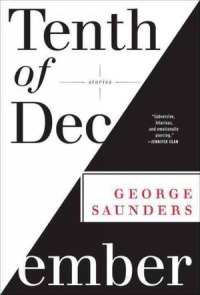
Tenth of December by George Saunders

Published by Random House on January 8, 2013

Sometimes morbid, sometimes zany, often touching, and always original, the stories collected in Tenth of December are written in a light, conversational style -- typically the kind of conversation you'd have with someone who is a little dim -- that conceals their deeper meaning. Many of the characters are like the parents or children you're glad you never had.

My favorite story, "Victory Lap," begins in the mind of Alison, a fifteen-year-old girl whose internal commentary on Eleanor Roosevelt, her ethics teacher's husband's affair, her own ignorance, and the dorkiness of Kyle Boot is, to use Alison's favorite word, awesome. The story then shifts to the scattered mind of Kyle Boot (favorite word: "gar"), whose chance of pleasing his anal-retentive father is nil and whose thoughts are filled with imaginative curses that he would never dare say out loud. When Kyle sees a man trying to kidnap Alison, he must choose between intervening and finishing his chores. The story develops a new layer of oddness when we enter the mind of the kidnapper. The ending is surprisingly sweet as humor and horror give way to karma.

The title story is another standout. Robin is a pale, blubberish boy who invents his own martial arts system (Deadly Forearms) to fight the Nethers. Eber, old and rail-thin, no longer seems real to himself. Both Robin and Eber constantly engage in silent, imagined conversations. When Robin spots Eber (thinking he may be a Nether) walking around a frozen pond, Robin makes it his heroic mission to deliver Eber's coat to him without realizing why Eber left the coat behind. The story is a bittersweet combination of humor and sorrow and inspiration.

In another close contender for my favorite story, Mikey comes "Home" from the war after a court-martial, just in time to watch his mother and her new boyfriend being evicted. The mother of his kids has taken up with a new boyfriend in his absence. His barely contained rage results in low-level violence, but his actions are inevitably greeted with the ubiquitous (and thus meaningless) phrase "Thank you for your service." None of that sounds amusing, but this serious story provokes unexpected laughter. It's better, I guess, to laugh than to cry.

I first read "Escape from Spiderhead" in The Best American Short Stories 2011. Saunders' futuristic take on chemically enhanced language and love was one of my favorite stories in that volume.

The remaining stories are all worth reading. More a vignette than a story, "Sticks" describes the way the narrator's father decorates a pole to commemorate Christmas, the Fourth of July, Veteran's Day, the Superbowl, Groundhog Day, an Earthquake in Chile, his wife's death, and, ultimately, his life. "Al Roosten" worries that noboby will bid on him at the anti-drug celebrity auction -- in fact, he worries about all sorts of things when his mind isn't buzzing with nonstop grandiose fantasies. A janitor in a medieval village is promoted to Pacing Guard after he witnesses his boss engaging in a sexual dalliance with another employee, a happy event that leads to "My Chivalric Fiasco" when he gets carried away with the role. The lives of two moms who are each doing their best, albeit in very different ways, intersect in "Puppy." Saunders takes a comical look at the power of positive thinking, in form of a memo from the boss, in "Exhortation."

Every story in Tenth of December is the product of a delightfully strange imagination, the work of an accomplished writer with a distinctive style. This is a collection of small gems that perfectly balance plot and character development. There isn't a dud in the bunch.

RECOMMENDED

Saturday
Jun162012

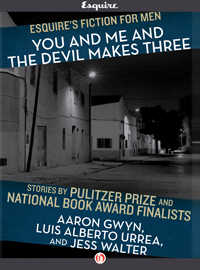
You and Me and the Devil Makes Three (Esquire's Fiction for Men)

Published by Esquire on June 5, 2012; distributed digitally by Open Road Media

The first installment of Esquire's "Fiction for Men" series -- available exclusively as an ebook -- only partially fulfills its mission, described as publishing "the type of original short stories men love to read -- plot-driven, immediate, essential, and impossible to put down." I think men (and women) love to read good fiction, whether plot-driven or character-driven, but even by Esquire's narrow standards, only two of the three merit attention. Those two, however, make the volume worth reading.

The title story, by Aaron Gwyn, is written in spare prose that suits a spare idea: a young coke user has a harrowing experience and, months later, finds himself in a room filled with lawyers and the family members of a murder victim. The story is written in the second person, a technique that rarely works, but my more significant complaint is that the scant power generated in the middle section of the story is wasted. The story's final scene is pointless and utterly unrealistic.  (Not recommended)

In Jess Walter's "Big Man," the middle-aged members of a spectacularly unsuccessful recreational league basketball team decide to recruit a big man to play in the post -- the boyfriend of a team member's ex-wife. The story is peppered with intelligent humor but it's also poignant in its exploration of a man who confronts the end of a season -- not a basketball season, but a season of his life.  (Highly recommended)

"Young Man's Blues" by Luis Alberto Urrea is a slice of a young man's life. He makes a daring decision to do the right thing but there will eventually be a price to pay. Characters have strong, believable personalities and the tension in the story's second half is palpable. (Recommended)

RECOMMENDED

Page 1 ... 12 13 14 15 16